

You’ve decided you want a retreat. Good. Now you’ve opened 15 browser tabs and every single one looks the same. Beautiful locations. Beautiful women in white. Beautiful words like “transformative” and “life-changing” and “soul-awakening.” And you have no idea how to tell the real from the performance.
Let me tell you honestly this guide won’t tell you which retreat to book. It will teach you how to choose, so the money you spend and the time you take actually gives you what you need, not what simply looks good on Instagram. Because understanding what happens at a women’s retreat in India is just as important as choosing the right one.
The 7 Questions to Ask Yourself Before Choosing a Retreat
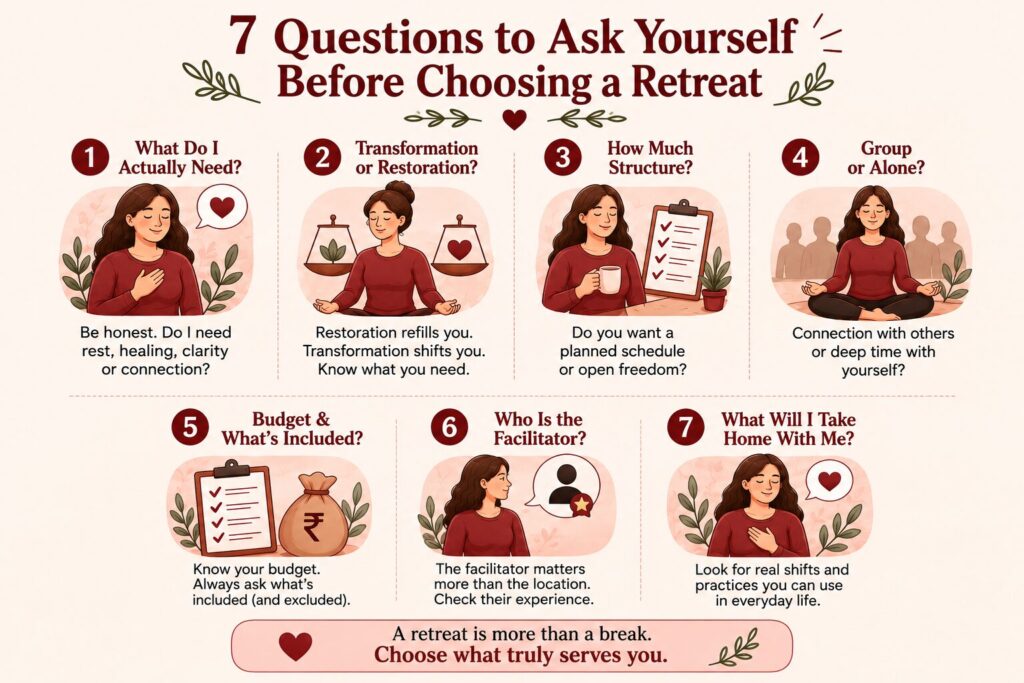
Before you look at a single retreat website, answer these for yourself. Because the right retreat depends entirely on what YOU need. Not what’s trending. The 7 questions to ask yourself before booking a women’s retreat.
1. What Do I Actually Need Right Now?
This sounds obvious. It isn’t. Most women book a retreat based on what looks appealing rather than what they actually need. A woman who needs emotional depth books a yoga retreat because the photos were pretty. A woman who needs rest books an intense inner-work retreat because the facilitator was convincing.Wrong match. Wasted money. Wasted time.
Sit with this question honestly before you open a single website. Do I need rest? Emotional healing? Connection? Silence? Clarity? Purpose? The answer changes everything about what you should look for. You might wonder “how to choose women’s retreat in India” that actually is helpful. I’ve watched women skip this question because it’s uncomfortable, and they almost always end up choosing the retreat that looks good instead of the one they actually need.
2. Am I Looking for Transformation or Restoration?
I’ve seen this happen again and again. The retreat itself wasn’t wrong; the timing was. These are two very different things. Restoration means you’re depleted and need to refill. Transformation means something inside needs to shift: a pattern, a belief, a way of living that isn’t working anymore.
A spa retreat restores. An emotional freedom retreat transforms. Both are valid, but if you book restoration when you need transformation, you’ll come back rested but unchanged. If you book transformation when you need restoration, you’ll come back overwhelmed..
Know which one your body and mind are asking for right now.
3. How Much Structure Do I Want?
Some retreats are tightly structured, with every hour planned, sessions back to back, guided from morning to evening. Others simply give you the space to do what you feel, when you feel it. Neither is better; it depends on you.
If you’re someone who needs guidance, choose structure. If you’re someone who needs freedom, choose openness. If you’re not sure, choose a retreat that offers structured sessions alongside unstructured time. That balance is usually the sweet spot.
4. Do I Want to Be in a Group or Alone?
Group retreats give you connection, shared experience, and the power of hearing other women’s truths. Solo retreats give you silence, depth, and zero social navigation.
An introvert who recharges alone will find a 30-woman group retreat draining rather than restorative. A woman who heals through connection may find a solo silent retreat isolating instead of freeing.
Know yourself. Choose accordingly. And if you choose a group, check the size: 10 to 12 women feels like intimacy. While 50 women start to feel like a conference with yoga.
5. What Is My Budget, and What Does It Actually Include?
Women’s retreats in India range from ₹15,000 to ₹2,00,000+. Price alone tells you nothing about quality.
Ask what’s included. Accommodation? Meals? All sessions? Airport transfer? Materials? Some retreats quote a low price then charge extra for everything. Others include everything in one transparent fee.
Also ask what’s excluded: flights, personal sessions, spa treatments. Hidden costs can turn a ₹50,000 retreat into a ₹90,000 surprise.
Decide your budget before you browse. Then ask every retreat exactly what’s included, in writing.
6. Who Is the Facilitator, and Why Does That Matter More Than the Location?
This is the question most women skip, and it’s the most important one.
A beautiful location paired with a weak facilitator gives you a holiday with nice food. A simple location paired with a powerful facilitator can give you a genuine turning point in your life.
Ask: Who is leading this retreat? What is their training? How many years have they been doing this? Have they done their own inner work, or are they mostly teaching theory? Can you find real testimonials from real women, with names and faces attached?
The facilitator is the retreat. Everything else is scenery.
7. What Will I Take Home With Me?
This is the question that separates a good retreat from a forgettable one.
After the final circle, after the goodbye hugs, after you’re back in your kitchen making chai, what stays? Memories, or actual shifts in how you think, feel, and respond?
A retreat worth attending gives you something that works on Tuesday morning when the kids are screaming, not only something that felt beautiful on Saturday afternoon in the mountains.
That’s usually where the real shift begins, not at the retreat itself, but in the ordinary moments when you notice you’re responding differently than you used to. That’s the real difference in a women’s retreat vs summer vacation, the experience doesn’t end when you return home.
Ask every retreat: what do participants take home? An “experience” points to a holiday. “Practices, awareness, and shifts they can apply in daily life” points to a retreat.
Red Flags When Choosing a Women’s Retreat in India
I’ve been asked to recommend retreats to women. I’ve also been asked to warn them. Here’s what I watch for:
- No facilitator bio or credentials are anywhere on the website. If they won’t tell you who’s leading, that’s a problem.
- Only stock photos, no real retreat images. Beautiful sunsets tell you nothing about what actually happens there.
- No refund or cancellation policy. A legitimate retreat has clear terms, and clear terms mean accountability.
- “Life-changing” promises with no substance behind them. Transformation is real, but a guarantee of it is usually a sign of a sales pitch.
- Very large group sizes with one facilitator. Forty women and a single person holding space starts to look like an event with a yoga mat rather than a retreat.
- No past participant reviews or testimonials, or only anonymous quotes with no names and no faces.
- Heavy upselling during the retreat. If you arrive and they start pitching a “premium upgrade” or a “next level program,” you’ve walked into a funnel, not a retreat.
A Simple Framework: Match the Retreat to Your Season of Life
If you’re wondering what is the best type of retreat for me, the answer depends on your current season of life rather than what’s trending. Not every retreat is for every woman. The right one depends on where you are right now, not where someone else thinks you should be.
| If you are | You probably need | Look for |
| Exhausted and running on empty | Pure restoration | Luxury wellness or nature slow-living retreat |
| Emotionally stuck and carrying old patterns | Inner transformation | Emotional freedom or NLP-based retreat |
| Physically depleted or recovering | Body reset | Ayurvedic Panchakarma or detox retreat |
| Spiritually seeking or at a crossroads | Depth and meaning | Spiritual retreat, ashram stay, or pilgrimage |
| Craving silence and deep stillness | Radical quiet | Vipassana or silent retreat |
| Lonely and needing connection | Sisterhood | Women-only group retreat with circle sharing |
| Unsure what you need | Guided discovery | A well-facilitated retreat with a flexible structure |
If you looked at this table and thought “I don’t know which one I am,” that’s the “unsure” row. The best thing you can do from there is talk to a facilitator who helps you figure it out, rather than one who sells you whatever they happen to be offering.
Where to Start Looking for Women’s Retreats in India
How to Find a Good Women’s Retreat in India
A few places to start:
BookRetreats.com and Retreat Guru list hundreds of retreats across India with filters for type, location, price, and duration. Good for browsing.
Instagram: search hashtags like #womensretreatindia #healingretreatindia. Beautiful content doesn’t equal quality facilitation, so look past the photos.
Word of mouth: ask women who’ve actually been, rather than influencers who were gifted a free stay. Real women who paid real money will tell you honestly.
Google search “women’s retreat [location] [type]” and read beyond the first page. The best retreats aren’t always the best at SEO.
Why the Facilitator Matters More Than Everything Else
I’ve seen women choose retreats based on the location. The Himalayas. Goa. Kerala. Beautiful choices. But a location can’t hold you when you cry. Location doesn’t know what question to ask when you’ve been silent for three hours. It doesn’t read the room and sense that today the group needs stillness rather than another session.
The facilitator does.
A facilitator who has done their own deep inner work holds space differently than one who learned facilitation from a weekend course. You can feel that difference within the first hour.
Before you book, research the person, not just the place. Read their content. Watch their videos. Notice if you feel something when they speak. That feeling is your compass.
“I created Fearless You because I couldn’t find what I was looking for”. Every women’s retreat in India was either a yoga holiday with nice food or a luxury spa break with inspirational quotes on the wall. But what happens at a women’s retreat should go far beyond relaxation, it should create lasting inner change.
Fearless You is different. It’s an emotional freedom retreat, built on Neuro-Associative Conditioning (NAC), designed to create lasting emotional freedom for Indian women, not just a few days of relaxation. Designed specifically for Indian women — women who understand the weight of family, culture, expectation, and the silent instruction to “adjust.”
Circles stay small — 10 to 12 women only. Locations are in nature across India, never a hotel conference room. I guide every retreat personally. It’s not yoga-focused. It’s emotional work focused. And the change carries home. It doesn’t fade by Monday.
9+ years. 300+ women. ICF certified. NAC practitioner.
Every woman who attends says the same thing differently: “I didn’t become someone new. I remembered who I was before I forgot.”
If something in this article spoke to you, start with the Carrying Too Much assessment. Built specifically for women—a short self-reflection form. From there, you can book a discovery call directly with me, Rasesha Rabari, or message me on WhatsApp if you’d rather ask your questions first.
You don’t need to be ready. You just need to be honest.
Frequently Asked Questions
How do I choose the right women’s retreat?
Start with yourself, rather than the retreat. Ask what you actually need: rest, transformation, connection, silence, emotional healing. Then find a retreat that matches your season, with the right facilitator and the right purpose for where you are right now.
What should I look for in a women’s retreat in India?
A credible facilitator with real experience. Small group size. Clear pricing with no hidden costs. Real testimonials from real women. A refund or cancellation policy. And most importantly, a retreat that can tell you exactly what you’ll take home with you, beyond just what you’ll experience while you’re there.
How much does a women’s retreat cost in India?
Anywhere from ₹15,000 to ₹2,00,000+ depending on location, duration, facilitator, and inclusions. Price doesn’t determine quality, so ask what’s included and what’s not. A cheap retreat that changes nothing often ends up costing more than an expensive one that does.
Is the facilitator more important than the location?
Yes, every time. A powerful facilitator in a simple ashram can change your life. A weak facilitator in a luxury resort mostly gives you a nice holiday. Choose the person who will hold you, not the place that will impress your Instagram.
What is the difference between a yoga retreat and an emotional healing retreat?
A yoga retreat focuses on physical practice: asanas, breathwork, meditation, body movement. An emotional healing retreat focuses on inner patterns: understanding why you feel what you feel, emotional repatterning, releasing what you’ve been carrying. Some retreats combine both, so know which one you need more of, body work or inner work, and choose accordingly.
Can I attend a women’s retreat alone?
Yes. Most women do. Coming alone is part of the power. You arrive without your social identity, your roles, or anyone who knows the version of you that you perform. You arrive as just yourself, and that’s where the real work begins. The women you meet there often become the most honest friendships you’ll ever have.