
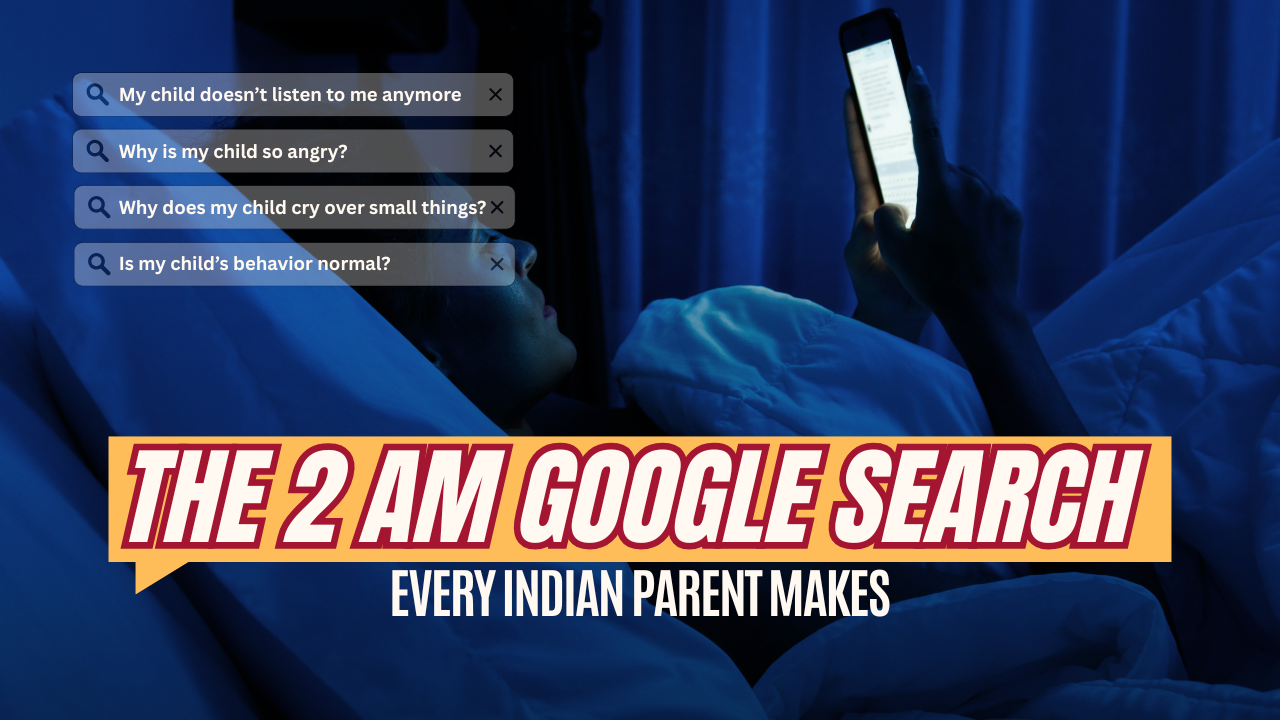
The 2 AM Google Search Every Indian Parent Makes
It’s 2 AM. The house is quiet. Everyone is asleep.
Everyone except you.
You’re lying in bed with your phone, the screen light cutting into the dark, typing something into Google that you’d never say out loud to another parent:
“Is my child’s behavior normal?”
Or maybe it’s:
“Why is my child so angry?”
“My child doesn’t listen to me anymore.”
“Is it normal for a 10 year old to have mood swings?”
“Why does my child cry over small things?”
You’ve read 14 articles. Some say it’s normal. Some say it’s ADHD. Some say it’s your parenting. Some say it’s their diet. Some say it’s screen time. Some say it’s hormones.
None of them feel like the answer.
And now you’re more confused than before, carrying a quiet fear that you won’t share with your spouse, your parents, or your friends: Is something wrong with my child?
If you’re a parent in Ahmedabad or anywhere in Gujarat and India and this is your 2 AM reality, I want to tell you something clearly:
Your child is not broken. And you are not failing.
But there IS something missing. Something no one, not their school, not their tuition, not any personality development class or summer camp in Ahmedabad or anywhere in India is providing. And it’s the reason their behavior doesn’t make sense to you.
The Question Behind the Question
When you search “is my child’s behavior normal,” you’re not really asking about normal. Normal is a statistical average that tells you nothing about YOUR child.
What you’re actually asking is: Why can’t I reach my child?
Why does a child who was open and loving two years ago now give one-word answers?
Why does a child who used to share everything now shut their door and put headphones on? Why does a child who was easy to manage now erupt over the smallest request?
The answer isn’t complicated. But it’s one that most parents never hear:
Your child’s brain is rewiring. Massively. And nobody told them or you what that means.
What’s Actually Happening Inside Your Child (Ages 8–14)
Between the ages of 8 and 14, the human brain goes through its second-biggest period of restructuring. The first was in the toddler years and you remember how that went. The tantrums, the meltdowns, the irrational crying over a broken biscuit.
This second wave is similar in intensity but completely different in expression. Here’s what’s happening:
The emotional brain is fully online and firing intensely. Feelings are bigger, more confusing, and more overwhelming than they have ever been.
The prefrontal cortex, the part that handles impulse control, rational thinking, planning ahead, and emotional regulation, is still under construction. It won’t be complete for another decade.
So your child is feeling more intensely than they ever have while having fewer tools to manage those feelings than you think they should. The gap between what they feel and what they can express is enormous. And that gap shows up as behaviour the kind that lands you on Google at 2 AM.
Research tells us that 42% of children aged 8 to 12 gradually stop sharing with their parents. This is not rejection. It’s a developmental milestone they’re beginning to form their own inner world, separate from you. It feels like a loss. But it’s growing.
The mood swings, the irritability, the “leave me alone” these aren’t signs of a bad child or bad parenting. They’re signs of a brain that’s under construction, experiencing emotions it doesn’t have the vocabulary or tools to process.
What Indian Parents Get Wrong (It’s Not Your Fault)
In most Indian households in Ahmedabad, across Gujarat, across India we operate on
an equation that was passed down to us:
Good behavior = good child. Bad behavior = needs discipline.
So when a child acts out, we correct the behavior. We scold. We lecture. We compare them to “better” children. We take away the phone. We threaten consequences.
And sometimes it works. The child stops the behavior. They comply. They go quiet.
But here’s what we miss: compliance is not the same as capacity. A child who stops acting out because they’re afraid of consequences hasn’t learned anything about themselves. They’ve learned to suppress. To perform. To manage your emotions instead of understanding their own.
Sound familiar? Because that’s exactly what most of us learned as children too. And we carried that suppression into adulthood into our relationships, our careers, our parenting.
In Indian homes, we teach respect. But we forget self-respect. We teach obedience. But we forget emotional intelligence. We push academic achievement because in our culture, grades equal family honour while emotional wellness is treated as something that will “sort itself out.”
It doesn’t sort itself out. It accumulates. It shapes everything. And it passes to the next
generation.
The cycle continues because the education gap continues. Generation after generation.
The Education Gap No One Talks About
Your child is expected to focus, without understanding how attention works.
Your child is expected to behave, without understanding what drives their reactions.
Your child is expected to be confident, without understanding who they actually are.
Your child is expected to handle pressure, without any tools for what happens inside
them when the pressure builds.
So they cope the only way they can: distraction, screen time, shutdown, outbursts,
avoidance, silence.
This is not a behavior problem. This is an education gap.
We teach children mathematics, science, history, and languages. We send them to tuitions, coaching classes, summer camps, and personality development workshops in Ahmedabad. We invest lakhs in their external education.
But we invest nothing in the one subject that determines how they handle everything else: understanding how their own mind, body, and emotions work.
We send our children to personality development classes in Ahmedabad hoping they’ll become confident. But confidence that’s built on speaking skills and body language without emotional intelligence underneath it crumbles the first time life gets hard. Real confidence comes from knowing yourself. That’s what Inner Literacy Education builds. No school in India teaches this. Not in Ahmedabad. Not in Gujarat. Not anywhere. This is what Inner Literacy Education is. And it’s the missing piece your 2 AM Google search is looking for.
What Changes When a Child Has Inner Literacy
When a child goes through Inner Literacy Education, the changes are subtle at first. Parents don’t see a dramatic overnight transformation. What they notice over weeks is something quieter and more profound:
The explosive moments become less frequent. Not because the child is suppressing but
because they’re recognising what’s happening inside before it escalates.
Conversations replace conflicts. The child starts telling you what’s wrong with words, not
with slammed doors or one-word answers.
Focus improves without force. Not because you took the phone away, but because the child understands how their own attention works.
Homework happens with less resistance. Not because of threats, but because the child understands their own patterns of avoidance and overwhelm.
Discipline happens from the inside. The child begins making choices not from fear of consequences but from understanding of themselves.
This is the difference between an emotional intelligence workshop and actual Inner Literacy Education. Workshops give information. Inner Literacy Education builds capacity, the ability to hold big emotions without breaking, to make decisions from clarity instead of panic, to handle peer pressure from self-trust instead of self-doubt. It’s emotional wellness education for children aged 8 to 14 and it doesn’t exist in any school, tuition centre, or coaching class in Ahmedabad or anywhere in Gujarat.
One mother in Ahmedabad described it like this: “I stopped needing to repeat myself. Not because he was scared of me. Because he was finally understanding himself.” That understanding is Inner Literacy. And once a child has it, they carry it for life. What Your 2 AM Search Was Actually Looking For You weren’t looking for a diagnosis. You weren’t looking for another parenting tip. You weren’t looking for reassurance that everything is “normal.”
You were looking for someone who understands what you’re seeing and can tell you what to do about it.
Here’s what to do: stop correcting the behaviour and start understanding the emotion underneath it. The behaviour is the alarm. The emotion is the fire. You can keep silencing alarms or you can address what’s actually burning.
And if you want your child to have the tools that neither you, nor I, nor any of us received growing up the tools to understand their own inner world that’s exactly what The Becoming provides.
The Becoming Gujarat’s Only Inner Literacy Education Program for Children The Becoming is a 6-month Inner Literacy Education program for children aged 8 to 14.
Every Sunday in Ahmedabad, Gujarat. Small batches of 8–10 children only, to ensure every child receives personal attention and feels safe to participate fully.
Your child learns how their mind, body, and emotions work together in simple, enjoyable ways they genuinely look forward to. Not therapy. Not tuition. Not personality development. Education for the inner world is the one subject that no school in Ahmedabad or anywhere in India provides.
Created and guided by RasEsha Rabari, mother of two grown adults (ages 26 and 28), NLP and NAC practitioner with 8+ years of mastery, author, and creator of Gujarat’s first and only Inner Literacy Education program for children. I’ve worked with 300+ individual clients across Gujarat and India. I don’t teach from theory. I teach from having lived every stage your child is going through.
The next batch in Ahmedabad is enrolling now. Only 8–10 children per batch. Limited
seats for Summer 2026.
Or start here: Is Your Child Emotionally Ready? a free 10-question assessment that
helps you understand where your child is strong and where Inner Literacy Education
could make a difference.
[Take the Free Assessment: Is Your Child Emotionally Ready? →]
Prefer WhatsApp? Message me directly at +91 917567678611 tell me your child’s age and what you’re seeing. I’ll tell you honestly whether The Becoming is the right fit.
You might also find these helpful:
→ Your Child Isn’t Stubborn — They’re Overwhelmed
→ You’re Not Lost. You’re Unbecoming Who You Were Told to Be. (For mothers who
are struggling too)
Written by RasEsha Rabari : Inner Literacy Education Expert & Emotional Wellness Coach, Ahmedabad, Gujarat. NLP & NAC Practitioner. Creator of Gujarat’s first and only Inner Literacy Education program for children aged 8–14. Author. 300+ clients across Gujarat and India.