

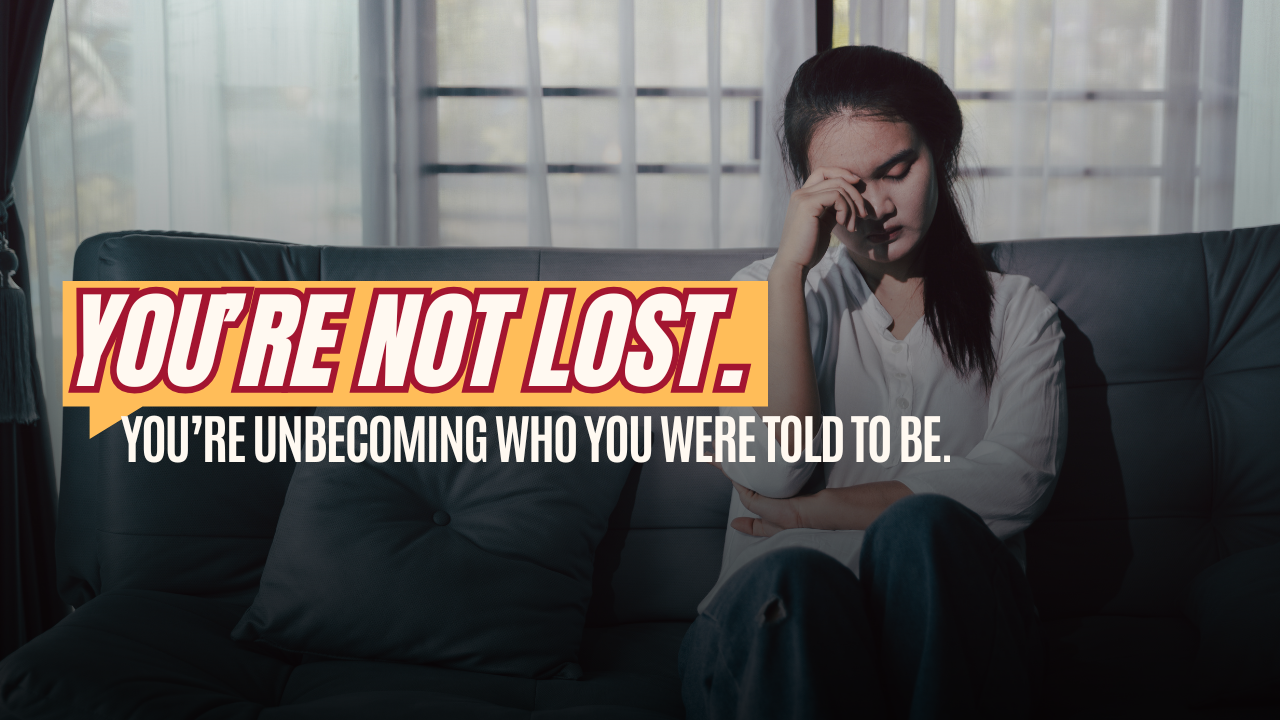
There’s a moment when it doesn’t come with warning when you look in the mirror and don’t recognise the person looking back.
Not physically. You look the same. Maybe a little more tired than you used to be.
But something behind the eyes has gone quiet. Something that used to burn a curiosity, a desire, an aliveness has been turned down so low that you forgot it was ever there.
You can’t name exactly when it happened. It wasn’t one event. It was a thousand small surrenders. A thousand “it’s fine.” A thousand moments of adjusting, accommodating, making peace with things that were never peaceful. And now, somewhere between being a wife, a mother, a daughter, a daughter-in-law, a professional, a caretaker you’ve disappeared. Not dramatically. Quietly. The way a colour fades when you’re not watching.
If you’re a woman in Ahmedabad, in Gujarat, or anywhere in India reading this you already know this feeling. You might just not have had the words for it until now. If something just tightened in your chest, stay with me. Because this isn’t a story about what’s wrong with you. This is a story about what happened to you. And there’s a difference.
The Disappearance Nobody Talks About
In India in Gujarat, in Ahmedabad, in households just like yours, women are taught from childhood that their purpose is relational. You exist in connection to others. You are someone’s daughter, someone’s wife, someone’s mother. Your value is measured by how well you hold everything together. And you do. Beautifully. Relentlessly. At enormous personal cost.
You manage the household. You manage the emotions of everyone in the family. You manage your career. You manage the school schedule, the in-law dynamics, the social expectations, the WhatsApp group pressures, the festival preparations, the emotional labour that nobody calls emotional labour because “that’s just what women do.” And somewhere in all that managing, you stopped living. You started functioning.
You stopped asking “What do I want?” because the question felt selfish. Or irrelevant. Or too big to answer.
Research bears this out. Studies consistently find that 40% of women in midlife particularly in their 30s through 50s experience a crisis of identity that has nothing to do with failure. It’s the opposite. They’ve succeeded at everything they were told to succeed at. And it feels empty.
The emptiness isn’t a sign that something is wrong with you. It’s a signal that the version of yourself you’ve been performing has reached its expiration date. People-Pleasing Isn’t Kindness. It’s Self-Abandonment.
Here’s a question: when was the last time you said “no” without guilt?
Not “no, but let me explain why.” Not “no” followed by three alternative offers to compensate. Just no.
If you can’t remember, that’s not a personality trait. That’s a pattern. And it has a cost. Every time you say yes to something you don’t want to do, you say no to yourself. Every time you manage someone else’s emotions at the expense of your own, you teach yourself that your feelings don’t matter. Every time you adjust one more time to keep the peace, you lose another inch of the person you actually are.
This isn’t kindness. It’s survival. It’s what happens when you’ve been taught explicitly or implicitly that your needs are secondary. Those boundaries are selfish. That a good woman holds it all together without complaining.
I work with women in Ahmedabad and across India who come to me saying “I know I people-please but I can’t stop.” The reason they can’t stop is because people-pleasing isn’t a habit, it’s a nervous system pattern. And you can’t think your way out of a nervous system pattern. You need precise emotional wellness tools NLP-based repatterning that work at the level where the pattern lives. And the exhaustion you feel? It’s not from doing too much. It’s from being too little of yourself for too long.
The Overthinking Trap
When a woman starts to feel this emptiness, this quiet unravelling, the mind does what it’s been trained to do: it tries to think its way out.
You replay conversations. You analyse what went wrong. You make lists of things to change. You compare yourself to women on Instagram who seem to have it figured out. You overthink whether you’re overthinking.
And none of it helps. Because this isn’t a thinking problem. It’s a feeling problem. And you can’t think your way to feeling alive again.
Overthinking isn’t planning. It’s avoiding it. It’s your mind’s way of staying busy so it doesn’t have to sit with the terrifying silence underneath the silence that whispers: I don’t know who I am anymore.
A survey found that 81% of Indians spend over three hours a day overthinking. For women carrying the weight of family, career, and emotional labour simultaneously, that number is likely higher. The mind spins because the body doesn’t feel safe enough to stop.
That whisper isn’t a weakness. It’s the beginning of something. It’s your real self, buried under years of performing, trying to get your attention.
The Cultural Weight Indian Women Carry
Let’s name what most wellness content in India won’t name: the cultural weight. In Indian families especially in Gujarat, saying “no” to elders is disrespectful. Setting a boundary with your in-laws is seen as selfishness. Wanting time alone is treated as abandonment. Wanting a career is weighed against being a “good mother.” Wanting emotional freedom is considered a luxury you haven’t earned.
You’re caught between honouring a culture you love and honouring a self you’re losing. And the guilt of even wanting something for yourself feels like betrayal.
This isn’t just your story. This is the story of thousands of women across Ahmedabad, across Gujarat, across India educated, capable, loving women who are carrying everyone except themselves.
Honouring your culture does not mean abandoning yourself. Respecting your family does not mean erasing your needs. Being a good mother, wife, and daughter does not require you to become invisible.
These two things can coexist. They must coexist. Because a woman who has lost herself cannot give what she doesn’t have.
What “Finding Yourself” Actually Means
Finding yourself isn’t a spa day. It isn’t a holiday. It isn’t reading one more self-help book or downloading one more meditation app.
Finding yourself is the work of unbecoming. Peeling away every identity that was given to you, expected of you, imposed on you — and sitting with what’s left.
It’s uncomfortable. It’s disorienting. And it’s the most important work a woman can do not just for herself, but for every relationship in her life.
Because a woman who knows herself doesn’t people-please. She doesn’t over-give from emptiness. She connects from fullness. She loves clarity. She parents from presence, not anxiety. She makes decisions from truth, not fear.
And here’s what most life coaches, therapists, and women’s wellness retreats in India won’t tell you: finding yourself isn’t comfortable. It’s not a women’s retreat where everyone does yoga and goes home feeling temporarily better. Real emotional freedom requires real emotional work. Emotional healing that lasts doesn’t come from relaxation it comes from confronting the patterns that have been running your life without your permission.
This isn’t selfish. This is the foundation everything else stands on.
The Shift That Changes Everything
The shift doesn’t happen through willpower. It happens through precise, guided emotional work the kind that reaches underneath the surface thoughts and touches the patterns that run your life without your permission.
NLP-based emotional repatterning is one of the most effective tools for this. Unlike talk therapy, which often keeps you circling the same stories, NLP works at the neurological level rewiring how you respond to guilt, shame, self-doubt, and the automatic “yes” that comes out before you even think. Combined with Neuro-Associative Conditioning (NAC), it creates lasting change not temporary relief.
This is the work behind the Fearless You emotional freedom retreat. Not motivation. Not another women’s circle where everyone shares and goes home unchanged. Precise emotional architecture that shifts how you relate to yourself permanently.
Women who go through this process describe it the same way: “I didn’t become someone new. I remembered who I was before I forgot.”
One retreat participant said: “From the very first session, I felt a quiet but meaningful shift. By the fifth day, the change became deeply personal, not just something I understood intellectually, but something I genuinely felt within myself.”
That’s the difference between information and transformation.
What You Can Do Tonight
Before any retreat, any coaching, any external support try this:
Sit somewhere quiet. Set a timer for 10 minutes. Close your eyes. And ask yourself one question: “What do I actually want?”
Not what your family wants. Not what’s practical. Not what makes sense. What do YOU want?
If nothing comes, that’s the answer. The silence is the evidence. You’ve been so far from yourself for so long that you’ve lost the signal.
That signal can be found again. That’s what this work is for.
Fearless You, A Retreat to Return to Yourself
If something in this article stirred something you’ve been carrying quietly Fearless You might be the space where you finally put it down.
It’s a women’s emotional freedom retreat in India, held in nature locations. Small circles of 10–12 women only. NLP-based inner work. NAC-based emotional repatterning. No performances. No quick fixes. Just a held space where you stop adjusting and start remembering.
This is not another women’s wellness retreat in India. This is deep, precise emotional wellness work created by an NLP and NAC practitioner with 8+ years of mastery for women who are done performing “fine” and ready to become who they actually are. Each Fearless You retreat is limited to 10–12 women only. This is not a conference. It’s intimate, held work. Spaces fill through word of mouth. If you feel the pull don’t wait.
You don’t need to be ready. You just need to be honest.
Or start with the free resource: The 7-Day Emotional Clarity Journal daily prompts to help you reconnect with yourself, one honest page at a time. Based on the NLP principles used in the Fearless You retreat.
You might also find these helpful:
→ Your Child Isn’t Stubborn They’re Overwhelmed (If you’re also a mother navigating your child’s emotions)
→ The 2 AM Google Search Every Indian Parent Makes
Written by RasEsha Rabari : Emotional Wellness Coach & Inner Literacy Education Expert, Ahmedabad, Gujarat. NLP & NAC Practitioner. Author. Creator of Fearless You an emotional freedom retreat for women across India. 300+ clients. 8+ years of mastery.