

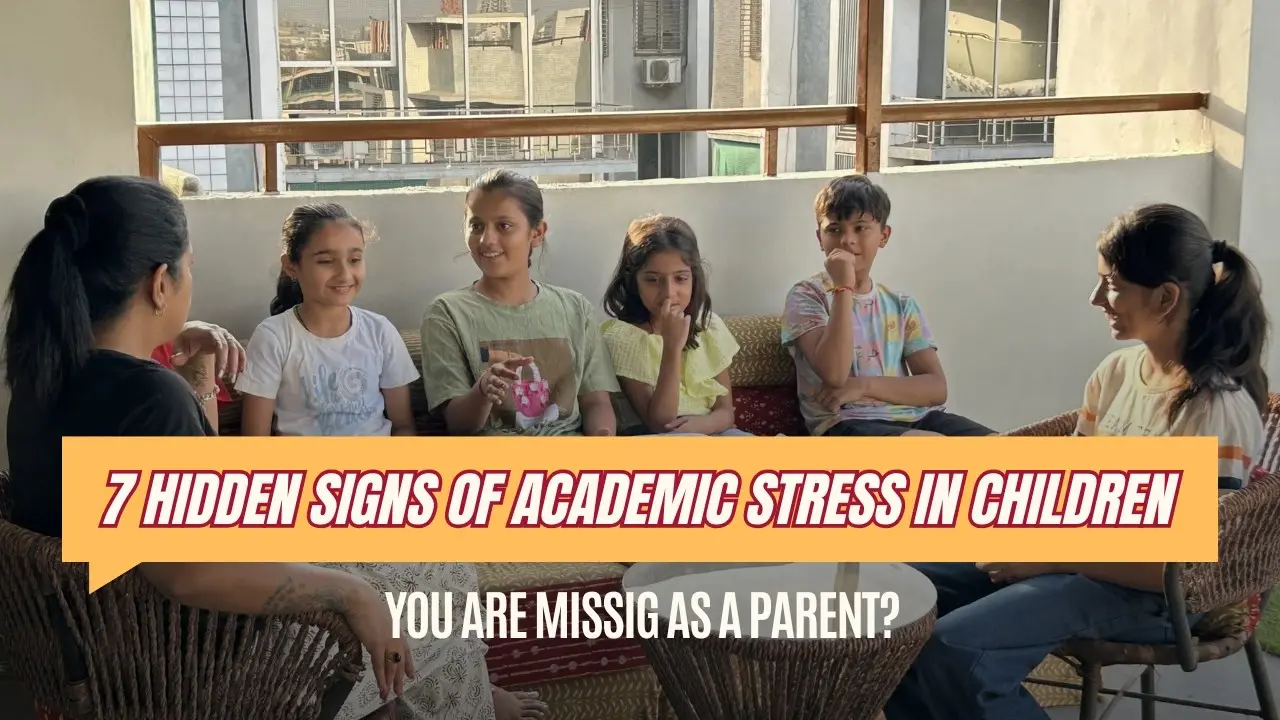
Your child isn’t crying about school. They aren’t refusing to go. They aren’t failing exams or getting calls from teachers.
So there’s no stress. Right?
That’s what most parents in Ahmedabad believe. Because we’ve been taught that stress looks dramatic, breakdowns, tears, and outright refusal. If the child is going to school, doing homework, and getting decent marks everything must be fine.
But academic stress in school children rarely announces itself.
And the reason you’re missing it isn’t because you’re not paying attention. It’s because you’re looking for the wrong signs.
What they’re really pointing to is a gap in your child’s emotional intelligence, not their report card.
That feeling is almost always right. And this article is about the 7 signs that feeling is pointing to the signs of academic stress that most Ahmedabad parents miss because they don’t look like stress at all.
Why Academic Stress in Indian Children Looks Different
Before I walk you through the signs I need you to understand why stress in students due to studies shows up differently in Indian homes than what most parenting articles describe.
In western countries, a stressed child might say: “I’m overwhelmed. I need help. School is too much.” And a parent might respond with: “Let’s talk about it. Let’s reduce the pressure.”
In Indian families especially in Ahmedabad, across Gujarat that conversation rarely happens. Because three cultural forces make it nearly impossible:
- It marks equal family honour. In our culture, a child’s academic performance isn’t just about the child. It reflects on the parents, the family name, the tuition teacher, the school choice.
The pressure isn’t just internal, it’s relational. Your child feels the weight of YOUR expectations, even when you haven’t said a word. They see your face when the marks come. - Expressing struggle is weakness. Indian children are taught explicitly or implicitly that struggling is something you push through, not something you talk about.
“Study harder.” “Focus more.” “Stop being lazy.” The message is clear: if you’re struggling, the problem is your effort, not the system. So the child stops saying they’re struggling. - The child’s coping mechanisms are invisible. A child in Ahmedabad doesn’t have the vocabulary to say “I’m experiencing academic stress.” They don’t know those words.
So the stress comes out sideways through their body, their mood, their relationships, their screen habits, their silence.
This is also why emotional well-being deserves as much attention as academic performance. Our guide to emotional wellness for children explores how children develop emotional awareness, resilience, and healthy ways to cope with pressure before stress begins affecting their behaviour and confidence.
That’s what makes school stress in kids so dangerous in Indian families. Not because the stress is worse. Because the silence around it is deeper.
7 Signs of Academic Stress Your Child May Not Be Showing Directly
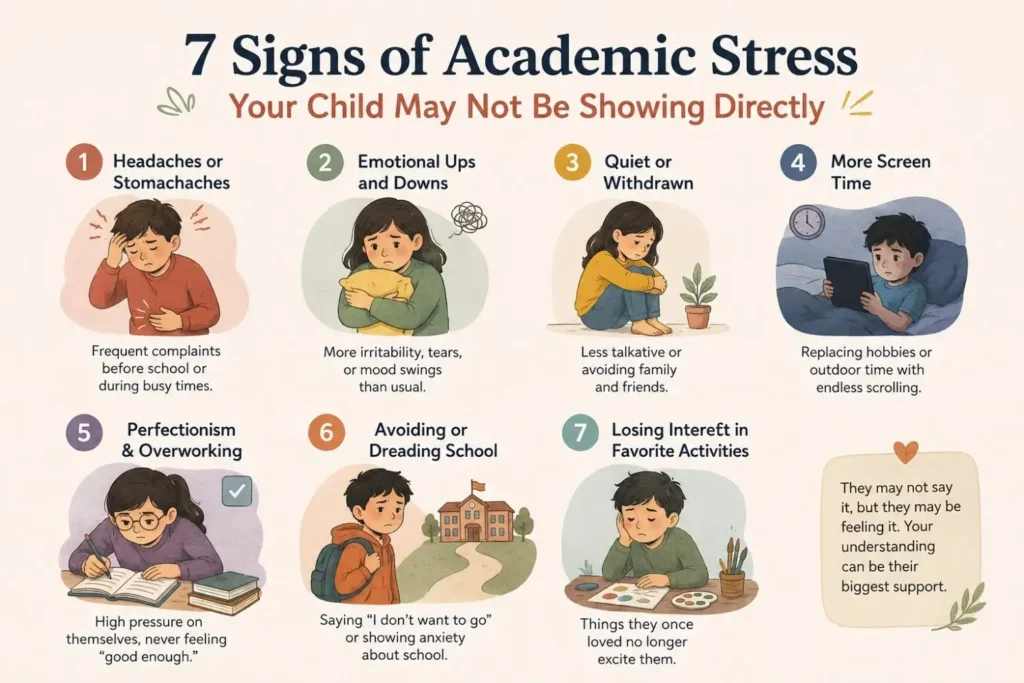
Sign 1: Stomachaches and Headaches That Only Happen Before School
What you see: Your child complains of stomach pain or headaches on school mornings. Weekends are fine. Holidays are fine. But Sunday evening or Monday morning, the complaints return. You’ve taken them to the doctor. Tests come back normal. The doctor says “nothing is wrong.”
What it actually is: Something IS wrong, it’s just not in the stomach. This is the body’s stress response. When a child’s nervous system is in low-level fight-or-flight from academic pressure, the body produces real, physical symptoms. The stomachache isn’t fake. A headache isn’t an excuse. It’s the body saying what the child can’t say with words: “I’m not okay.”
What to watch for: The pattern. If physical complaints consistently align with school days, exam weeks, or specific subjects that’s not coincidence. That’s the body keeping score.
Sign 2: They’re Fine at School, But Fall Apart at Home
What you see: Teachers say your child is well-behaved, participates, and socialises normally. But the moment they walk through your door everything changes. Snapping over dinner. Crying over nothing. Picking fights with siblings. Slamming their room door. You think: how can they be perfectly fine at school and completely fall apart at home?
What it actually is: They’re not fine at school. They’re PERFORMING fine at school. Your child spends 6-8 hours holding themselves together managing impressions, suppressing emotions, meeting expectations and they walk through your door with absolutely nothing left. Home is where the mask comes off. The meltdown isn’t about what happened at dinner. It’s about what they carried all day and couldn’t express until they felt safe enough. And ironically they feel safest with you. So you get the explosion.
What to watch for: The timing. If the worst behaviour consistently happens within the first hour of coming home that’s not “bad behaviour.” That’s a child unloading a full day of emotional labour. The question isn’t “why are they being difficult?” It’s “what did they carry today that they couldn’t put down?”
Sign 3: They’ve Gone Quiet About School
What you see: They used to come home and tell you everything what the teacher said, what happened at lunch, who they played with. Now you get nothing. “How was school?” “Good.” “What happened today?” “Nothing.” Conversation closed. Door closed. You chalk it up to growing up.
What it actually is: Growing up explains some withdrawal. But when a child who was open goes completely silent about school it’s often because school has become a source of stress they don’t know how to articulate. They’re not being secretive. They’re being self-protective. Talking about school means feeling the stress again. So they shut the topic down. Silence isn’t an attitude. It’s armour.
What to watch for: The selectivity. If your child still talks about friends, hobbies, or weekend plans but specifically avoids school-related conversation the silence is targeted. That tells you exactly where the stress lives.
Sign 4: Screen Time Has Quietly Replaced Everything Else
What you see: They used to read. They used to play outside. They used to draw, build things, and ride their bicycles. Now it’s just the phone. YouTube. Instagram. Games. Hour after hour. You fight about it daily. Nothing changes.
What it actually is: The screen isn’t the problem. The screen is the only place where their brain gets relief from the pressure. Think about what a screen offers: instant dopamine, zero judgment, no performance expectations, no comparisons, no grades. For a child drowning in academic stress, the screen is the only space where nobody is measuring them. They’re not addicted to the phone. They’re addicted to NOT feeling the pressure. And nobody taught them any other way to decompress.
What to watch for: The desperation. There’s a difference between a child who enjoys screen time and a child who NEEDS it. If taking the phone away triggers panic, rage, or shutdown that’s not entertainment dependence. That’s emotional dependence. The screen is their only regulation tool. Which means the question isn’t “how do I reduce screen time?” It’s “what is my child running from?”
Sign 5: Perfectionism That Doesn’t Look Like Stress
What you see: Your child erases and rewrites answers until they’re flawless. Spends 3 hours on homework that should take 45 minutes. Gets 95% and is visibly upset it wasn’t 100%. Refuses to submit work unless it’s “perfect.” You think well, at least they care about quality.
What it actually is: This isn’t quality. This is fear wearing the mask of discipline. Your child isn’t striving for excellence. They’re terrified of inadequacy. Every imperfect answer feels like proof that they’re not good enough. The erasing, the rewriting, the 3-hour homework maratho that’s anxiety in disguise. The most dangerous kind because it looks like dedication.
What to watch for: The emotional response to imperfection. A child with healthy ambition feels disappointed by a bad mark, recovers, and tries again. A child with stress-driven perfectionism feels SHAME. The mark doesn’t just mean they got a question wrong. It means THEY are wrong. That’s the difference and it’s critical.
Sign 6: The “Good Child” Who Never Complains
What you see: They do everything they’re told. Homework without being asked. Obedience without resistance. No tantrums. No arguments. No complaints. Teachers love them. Relatives praise them. You think: I got lucky with this one.
What it actually is: You might have the most stressed child in the house and not know it. Because this child learned something early: complaining gets you nowhere. Expressing needs creates conflict. The safest path is compliance. So they perform “good” not because they feel good, but because being good is the only strategy that earns them safety and approval. Inside, they may be anxious, lonely, self-doubting, or emotionally numb. But you’ll never see it because they’ve become experts at hiding it.
What to watch for: The absence of negative emotion. A healthy child gets angry sometimes. Gets frustrated. Pushes back. Says “this isn’t fair.” If your child NEVER does any of this that’s not maturity. That’s suppression. And suppression doesn’t last. It accumulates quietly until it breaks often in the teenage years, often in ways that blindside everyone.
Sign 7: They’ve Lost Interest in Something They Used to Love
What you see: They used to paint for hours. Now the sketchbook collects dust. They used to love cricket. Now they don’t want to go for practice. They used to read before bed. Now they just scroll. You think interests change. Kids go through phases.
What it actually is: When academic pressure builds, the first things to go are the things that bring joy but don’t “count.” Painting doesn’t improve marks. Cricket doesn’t appear on a report card. Reading for pleasure doesn’t help in board exams. The child unconsciously begins sacrificing everything that feeds their soul because the only currency that matters in their world is performance. The loss of interest isn’t a phase. It’s a survival calculation. The child has decided consciously or not that there’s no room left for joy. Only for output.
What to watch for: Whether the loss is gradual or sudden. A gradual drift away from hobbies over months is concerning. A sudden, complete abandonment of something they loved is urgent. That child is not “growing out of it.” They’re drowning and cutting away everything that isn’t keeping them afloat.
What These Signs Are Not
Before you spiral into worry let me tell you what these signs are NOT.
They are not proof that your child has a clinical disorder. They are not evidence that you’ve failed as a parent. They are not a guarantee that something terrible is going to happen.
What they ARE is information. Data from your child’s body, behaviour, and emotional world telling you something they don’t have the words to say.
Some of these signs may appear temporarily during exam season and resolve on their own. That’s normal. Stress happens. It passes.
But if you’re seeing 3 or more of these signs consistently not just during exams, but as a pattern over weeks and months your child is carrying more than they should. And they need support that goes beyond “study harder” or “don’t worry.”
What You Can Do When You Notice These Signs
You don’t need a diagnosis. You don’t need a therapist’s appointment. You need a shift in how you see what your child is showing you.
Listen without fixing first. When your child shows a sign the stomach ache, the silence, the meltdown after school resist the urge to immediately solve it. Don’t say “you’ll be fine” or “stop worrying about marks.” Instead try: “I notice something seems heavy for you. I’m here. You don’t have to explain it right now but I’m here.” That alone can crack open a door that’s been sealed shut.
Separate performance from identity. Your child needs to hear clearly, repeatedly, believably that their worth is not their marks. Not once during an emotional conversation. Consistently. In how you respond to good results AND bad results. If you celebrate 95% and go silent at 75% your child learns exactly what earns your love. And they’ll perform for it at any cost.
Watch the pattern, not just the moment. One stomachache is a stomachache. One meltdown after school is a bad day. But a pattern the same sign showing up week after week is a message. Your child’s behaviour is communication. Start reading it like a language, not a problem.
Consider building inner tools not just managing outer triggers. Reducing academic pressure helps. Changing schools helps sometimes. But unless your child develops the internal capacity to recognise their stress, name it, and work with it the pattern will follow them to the next school, the next exam, the next stage of life. Inner tools last. External adjustments are temporary.
Building Inner Tools: What Ahmedabad Parents Are Choosing
More parents in Ahmedabad are realising that the answer isn’t less pressure because pressure isn’t going away. Board exams will come. Competition will come. Career decisions will come.
The answer is more capacity building a child who can hold pressure without breaking. It’s a big part of why parents are choosing emotional education for kids over quick fixes.
This is what Inner Literacy Education does. It teaches children aged 8 to 14 how their mind, body, and emotions work together so they can recognise stress in their body before it becomes a stomachache, name what they’re feeling instead of shutting down, and regulate their response instead of exploding or disappearing.
The Becoming is Gujarat’s first and only Inner Literacy Education program. 6 months. 24 sessions. Every Sunday in Ahmedabad. Small batches of 8–10 children. Created and guided by me, RasEsha Rabari 9+ years of practice in NLP and Neuro-Associative Conditioning, ICF certified, 300+ families served.
If you recognised your child in 3 or more of the signs above don’t wait for it to become a crisis. Start with understanding.
→ Fill the Understanding Your Child Form 13 Questions, 5 MinutesFrequently Asked Questions
What are the signs of academic stress in children?
The most common signs are physical complaints before school (stomachaches, headaches with no medical cause), meltdowns at home despite being at school, withdrawal from conversations about school, increased screen dependence, perfectionism, over-compliance, and loss of interest in hobbies they used to love. These signs are easy to miss because they don’t look like stress they look like behaviour, attitude, or phases.
How do I know if my child is stressed about school?
Watch for patterns, not just moments. One bad day is normal. But if you’re seeing the same signs the silence, the stomachaches, the explosions after school, the screen addiction repeating week after week, your child is carrying more than they should. Trust your instinct. If something feels off, it probably is
Why is my child so irritable at home but fine at school?
Because school is where they perform. Home is where the mask comes off. Your child spends the entire school day holding themselves together managing impressions, meeting expectations, suppressing emotions. When they walk through your door, they have nothing left. The meltdown isn’t about dinner. It’s about everything they carried all day. You get the explosion because you’re the safest person in their world.
What can I do to help my child with academic pressure in Ahmedabad?
Start by listening without fixing. Separate their worth from their marks consistently, not just once. Watch for patterns in their behaviour. And consider building their inner capacity teaching them how to recognise stress, name it, and regulate it rather than just managing external triggers. In Ahmedabad, The Becoming by RasEsha Rabari offers Inner Literacy Education for children aged 8–14, teaching them practical emotional tools they can use every day. Start with the free Understanding Your Child form or book a discovery call.