

You’re not reading this because your child came to you and said “I’m struggling emotionally.” That almost never happens. Not in Indian families. Not at ages 8 to 14. Not in a culture where children are taught to manage, adjust, and carry on.
You’re reading this because of a feeling. Something you’ve noticed but can’t quite name. Something that doesn’t fit neatly into a complaint to the school or a visit to the paediatrician.
Maybe it’s the way they shut down after school. Maybe it’s how a small disappointment ruins the entire evening. Maybe it’s the fact that they used to tell you everything and now you get nothing. Maybe it’s a heaviness in the house that nobody is talking about.
You’ve probably told yourself: “It’s just a phase.” “They’ll grow out of it.” “All kids go through this.”
And maybe they will. But maybe the fact that you’re still here, still reading, still carrying this quiet worry at 11 PM means part of you already knows this isn’t just a phase.
That’s why more families are beginning to see Emotional Education for Children as something that belongs before a crisis, not after one. It’s about helping children understand themselves while they’re still growing, not waiting until they’re already struggling.
This article is for that feeling. Here are 8 signs that your child may need emotional wellness support, the kind that most parents miss because it doesn’t look like what they expect.
8 Signs Your Child May Need Emotional Wellness Support
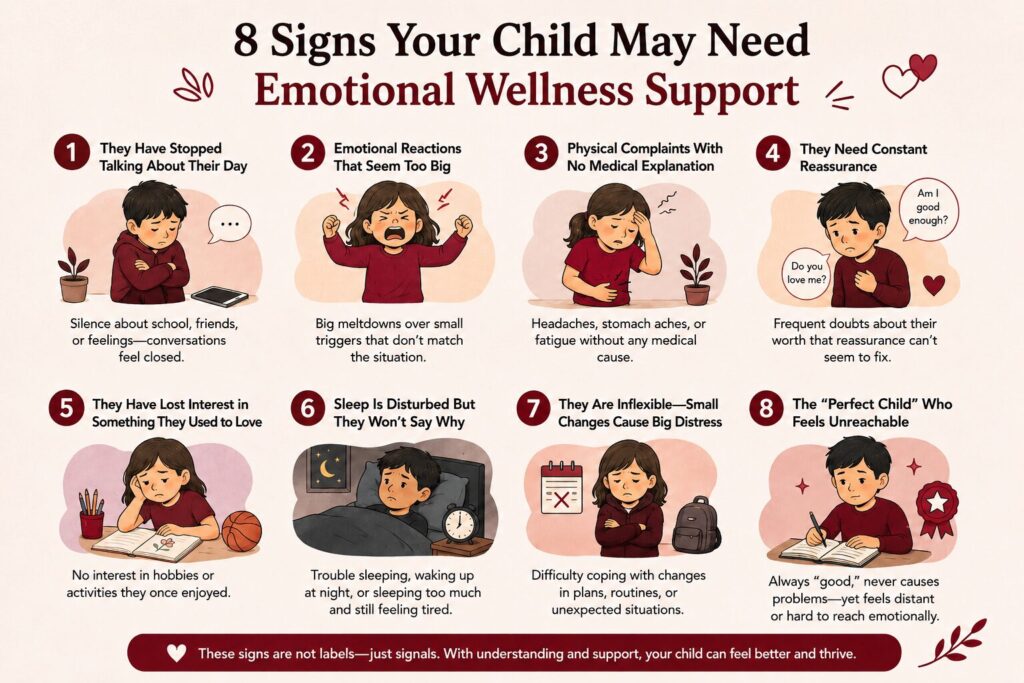
Sign 1: They Have Stopped Talking About Their Day
What you see: You ask “How was school?” and get “Good.” You ask “What happened?” and get “Nothing.” You try different angles they shut every one down. Conversation about school, friends, feelings — closed. It wasn’t always like this. They used to come home bursting with stories. Now you get silence and a screen.
What it may indicate: Your child hasn’t lost interest in talking to you. They’ve simply run out of words for what they’re feeling. So they protect themselves by staying quiet. This silence isn’t an attitude. It’s often the first place where emotional wellness for children begins to show signs of struggle.
What to watch for: The selectivity. If they still chat freely about games, movies, or weekend plans but go silent specifically about school, friends, or feelings the silence is targeted. That tells you exactly where the weight is sitting.
Sign 2: Emotional Reactions That Seem Too Big for the Trigger
What you see: You said “no” to ice cream. They screamed for 20 minutes. A sibling touched their notebook. Full meltdown. You asked them to turn off the TV. Tears, shouting, “you don’t understand me.” The reaction never matches the situation. It’s always too much. Too loud. Too long.
What it may indicate: The ice cream isn’t the problem. The notebook isn’t the problem. These are the last drops in a glass that was already full. Your child has been accumulating emotional weight all day, frustration, comparison, pressure, loneliness, confusion and the glass finally overflows at the smallest trigger. The outburst isn’t about the moment. It’s about everything that came before the moment. A child who explodes over small things is a child whose emotional capacity has reached its limit and nobody taught them how to empty the glass before it overflows.
What to watch for: Frequency and escalation. An occasional overreaction is normal. But if it’s happening daily, if the explosions are getting bigger, lasting longer, or coming from increasingly small triggers your child’s emotional system is signalling that it needs more capacity than it currently has.
Sign 3: Physical Complaints With No Medical Explanation
What you see: Stomach aches before school. Headaches during exam week. “My legs hurt” on Sunday evening. You take them to the doctor. Blood work is fine. Scans are normal. The doctor says “nothing is wrong.” But your child is still in pain.
What it may indicate: Something is wrong, it just isn’t in the body the way medicine looks for it. When a child’s nervous system carries chronic low-grade stress from academic stress in school children, social anxiety, family tension, or emotions they can’t name, the body produces real, physical symptoms. The stomach ache isn’t fake. The headache isn’t an excuse. It’s the body keeping the score that the mind can’t express. This is how child emotional wellbeing breaks down when there’s no outlet the body speaks what the mouth cannot.
What to watch for: The pattern. If physical complaints consistently appear before school, during exam periods, or on specific days (Sunday evenings are the most common in families I work with in Ahmedabad) that’s not coincidence. That’s the body’s calendar telling you when your child’s stress peaks.
Sign 4: They Need Constant Reassurance But It Never Seems to Stick
What you see: “Am I good enough?” “Do you love me?” “Will you be angry if I get less marks?” “Am I stupid?” You answer every time. Sincerely, Warmly. “Of course I love you. Of course you’re good enough.” And for a few minutes they seem relieved. Then the next day, the same questions return. As if yesterday’s reassurance evaporated overnight.
What it may indicate: This isn’t a child seeking attention. This is a child whose self-trust has been damaged possibly by comparison, academic pressure, or the unspoken message that love is conditional on performance. Your reassurance isn’t sticking because you’re trying to fill a hole from the outside. But the hole is on the inside. The child doesn’t doubt your love. They doubt their own worthiness. That’s a fundamentally different problem and it requires internal tools, not external validation.
What to watch for: Whether the reassurance-seeking is escalating. If it started as occasional and has become daily or if the questions are becoming more specific and painful (“Am I your least favourite child?” “Would you be happier if I was smarter?”) the inner wound is deepening, not healing. More reassurance won’t fix this. Building self-trust will.
Sign 5: They Have Lost Interest in Something They Used to Love
What you see: They used to draw for hours. The sketchbook is untouched. They used to beg to play cricket. Now they don’t even want to go outside. They used to read before bed. Now it’s just scrolling. You think interests change. Kids go through phases.
What it may indicate: When emotional weight builds, the first things a child drops are the things that bring joy but don’t “count.” Drawing doesn’t improve marks. Cricket doesn’t appear on a report card. Reading for pleasure doesn’t help in board exams. The child isn’t losing interest. They’re making a survival calculation cutting everything that doesn’t serve the only currency that seems to matter: performance. The loss of joy isn’t a phase. It’s a child deciding there’s no room left for who they want to be only for who they’re expected to be.
What to watch for: Whether the loss is gradual or sudden. A slow drift away from hobbies over months is concerning. A sudden, complete abandonment of something they loved is urgent. That child is not growing out of it. They’re drowning and cutting away everything that isn’t keeping them afloat.
Sign 6: Sleep Is Disturbed But They Won’t Say Why
What you see: They can’t fall asleep. Or they fall asleep but wake up in the middle of the night. Or they sleep too much 10, 11 hours and still seem tired. You ask what’s wrong. “Nothing.” You ask if something happened. “No.” The sleep problem persists but the explanation never comes.
What it may indicate: Sleep is the first system the body sacrifices when the mind is in overdrive. A child who can’t fall asleep is a child whose brain won’t stop processing replaying the day’s events, rehearsing tomorrow’s worries, comparing themselves to classmates, carrying unspoken fears. A child who sleeps too much is a child whose emotional system is exhausted from carrying weight it was never designed for. Both are signs that the nervous system is dysregulated running too hot or shutting down entirely. And the child won’t tell you why because they often don’t know why themselves. They just know they can’t sleep. Or can’t stop sleeping.
What to watch for: Duration. A few nights of disturbed sleep during exam week is normal. But if sleep disruption persists for weeks independent of any specific event your child’s emotional system is asking for support it isn’t getting.
Sign 7: They Are Inflexible Small Changes Cause Big Distress
What you see: You change the dinner plan meltdown. A playdate gets cancelled inconsolable. You take a different route to school anxiety. The family plans shift complete shutdown. It looks like stubbornness. It feels like your child is being “difficult.” But the intensity of the reaction doesn’t match the change.
What it may indicate: Inflexibility is rarely about the specific change. It’s about control. When a child’s inner world feels chaotic when emotions are unpredictable, when school feels pressured, when they don’t understand what’s happening inside themselves they cling to external predictability as a survival mechanism. The dinner plan, the playdate, the route to school these are the few things that feel stable. When even those shift, the child loses their last anchor. The meltdown isn’t about dinner. It’s about a child who feels like nothing in their world is within their control including themselves.
What to watch for: Whether the inflexibility is increasing. If your child was once adaptable and has gradually become rigid about routines, plans, and changes that trajectory matters. Increasing rigidity is a child’s emotional system tightening its grip because the inner world feels increasingly unsteady.
Sign 8: The “Perfect Child” Who Never Causes Problems But Feels Unreachable
What you see: They do everything right. Homework without being asked. Obedience without resistance. Good marks. No complaints. No tantrums. No arguments. Teachers love them. Relatives praise your parenting. On paper the ideal child.
What it may indicate: This might be the child who needs emotional wellness support the most and gets it the least. Because nobody sees a problem. Including you. This child learned something very early: expressing needs creates conflict. Showing struggle creates disappointment. The safest strategy is perfection. So they perform “good” not because they feel good, but because being good is the only strategy that earns them safety, approval, and love.
Inside, they may be anxious, lonely, self-doubting, or emotionally numb. But you will never see it because they’ve become experts at making sure you don’t. The absence of problems IS the problem. A healthy child pushes back sometimes. Gets frustrated. Says “this isn’t fair.” If your child NEVER does any of this that’s not maturity. That’s a child who has decided that their real self isn’t safe to show.
What to watch for: The distance. Not conflict. Distance. If you feel like you know everything about your child’s schedule but nothing about their inner world if conversations are polite but never real if they’re performing the role of “good child” so flawlessly that you can’t remember the last time they were messy, angry, or raw that perfection is a wall. And behind it is a child you haven’t met yet.
What These Signs Are Not
I want to be clear about something before your worry spirals.
These signs are not proof that your child has a clinical condition. They are not evidence that you’ve failed as a parent. They are not guarantees that something terrible will happen.
What they ARE is communication. Your child’s body, behaviour, and emotional patterns speaking a language that words haven’t learned yet.
Some of these signs may appear temporarily during exam season, after a fight with a friend, or during a family transition and resolve on their own. That’s stress. It happens. It passes.
But if you’re seeing 3 or more of these signs consistently not just during exams, but as a pattern across weeks and months your child is carrying more than they know what to do with. And they need support that goes beyond “it’ll pass” or “try harder.”
When to Seek Professional Therapy vs. When to Seek Emotional Education
This is the distinction that matters most and the one nobody else is making clearly.
Seek emotional education (like The Becoming) when:
Your child is functioning but struggling underneath. They don’t have a diagnosis they have a gap. They can’t name what they feel. They react instead of responding. They cope through screens, silence, or outbursts not because something is clinically wrong, but because nobody ever taught them how their inner world works. They need tools. They need vocabulary. They need self-understanding. This is education, not treatment. It builds capacity in any child whether they’re struggling visibly or silently.
Seek professional therapy when:
Your child shows signs of clinical severity persistent panic attacks, self-harm, suicidal thoughts, complete withdrawal lasting weeks, inability to attend school, diagnosed conditions like OCD, severe anxiety disorder, or depression. Therapy is essential, clinical, and delivered by trained mental health professionals. If your child is in this space please seek a qualified therapist. Emotional education can complement therapy beautifully, but it is not a substitute for clinical care.
The majority of children I work with in Ahmedabad fall into the first category. They don’t need a diagnosis. They need someone to teach them what nobody else is teaching them how to understand themselves.
How Emotional Wellness Support Works for Children in Ahmedabad
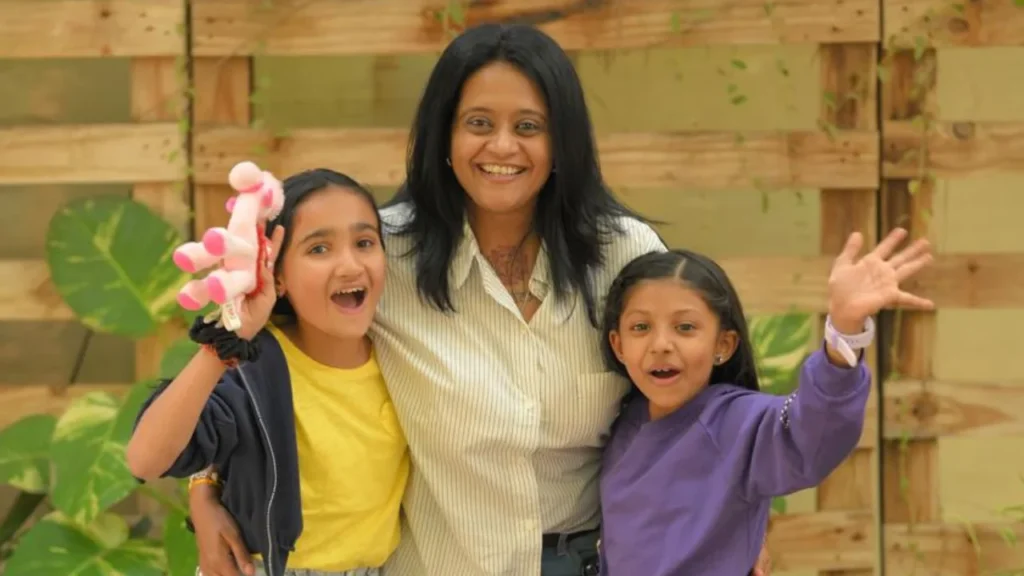
Emotional wellness support for kids doesn’t look like what most parents imagine. It’s not a therapist’s couch. It’s not a classroom lecture about feelings. It’s not a motivational talk that fades by Monday.
In Ahmedabad, The Becoming is Gujarat’s first and only Inner Literacy Education program designed specifically for children aged 8 to 14 who need to understand how their mind, body, and emotions work together.
Over 6 months and 24 sessions every Sunday children learn body awareness (catching the emotion in their body before it becomes behaviour), emotional vocabulary (naming feelings beyond “I’m fine”), self-regulation (choosing a response instead of being hijacked by a reaction), and self-trust (knowing who they are without needing constant external validation).
Small batches of 8–10 children. Created and guided by me, RasEsha Rabari 9+ years of NLP and Neuro-Associative Conditioning practice, ICF certified, 300+ families across Gujarat.
Children don’t just attend. They look forward to it. Not a single child has wanted to miss a session. Because for the first time, someone is teaching them something that makes their everyday life easierand they feel the difference immediately.
If you recognised your child in 3 or more of the signs above don’t wait for the phase to pass. Start with understanding.
Frequently Asked Questions
Q: What are the signs a child needs emotional wellness support?
The most common signs include withdrawal from conversation, emotional reactions that don’t match the trigger, physical complaints with no medical cause, constant need for reassurance, loss of interest in things they loved, sleep disturbance, inflexibility around small changes, and the “perfect child” pattern where they never complain but feel emotionally unreachable. These signs are easy to miss because they don’t look like distress they look like behaviour, attitude, or phases.
Q: Is emotional wellness support the same as therapy?
No. Therapy addresses diagnosed clinical conditions and is delivered by licensed mental health professionals. Emotional wellness support like Inner Literacy Education is educational. It builds emotional capacity, self-understanding, and practical tools in any child. One is treatment. The other is foundation. They can work together, but they serve different purposes.
Q: How do I know if my child’s emotional reactions are a sign of a bigger issue?
Watch for patterns, not isolated moments. One meltdown after a hard day is normal. But if the same reactions explosions, withdrawal, silence, physical complaints repeat week after week regardless of what’s happening externally, your child is carrying more than the moment. Consistent patterns across weeks are the signal that something deeper needs attention.
Q: Are there emotional wellness support programs for children in Ahmedabad?
Yes. The Becoming by RasEsha Rabari is Gujarat’s first and only Inner Literacy Education program for children aged 8–14. Every Sunday in Ahmedabad. Small batches of 8–10 children. 6 months. 24 sessions. It teaches children how their mind, body, and emotions work through practical tools they can use in everyday life.
Q: What is the difference between a “phase” and a sign that something needs attention?
A phase is temporary; it appears during a specific event (exam week, a friendship conflict, a family change) and resolves when the event passes. A sign is persistent; it shows up repeatedly, across different contexts, over weeks or months, regardless of external circumstances. If the same pattern keeps appearing even when the external trigger has passed it’s not a phase. It’s a pattern. And patterns need more than patience. They need tools.
Q: At what age should I be concerned about my child’s emotional health?
Emotional awareness can begin at any age, but the critical window is 8 to 14. This is when the brain undergoes its most intense emotional restructuring, social complexity increases dramatically, and identity formation begins. The tools built during this window become the emotional operating system your child carries for life. If you’re noticing signs now don’t wait for them to “grow out of it.” This is the window where support creates the deepest, most lasting impact.