
You’ve tried everything
You’ve set time limits. You’ve hidden the charger. You’ve had “the talk” about screen addiction calmly, firmly, desperately. You’ve taken the phone away for a week. You’ve bribed them with outings. You’ve yelled. You’ve cried. You’ve Googled “how to reduce my child’s screen time” so many times that Google probably thinks you’re writing a research paper.
And nothing has changed. Not really.
The phone comes back. The iPad reappears. The YouTube shorts resume. The glazed eyes return. The one word answers. The irritation when you interrupt. The meltdown when you try to enforce a rule.
If you’re a parent in Ahmedabad or anywhere in Gujarat and India and your child is between 8 and 14 years old, there’s a very good chance this is your daily reality. A 2026 report flagged digital addiction as a major public health threat to India’s long-term productivity. 73% of Indian parents cite phone usage as their top concern about their child.
But here’s what nobody is telling you:
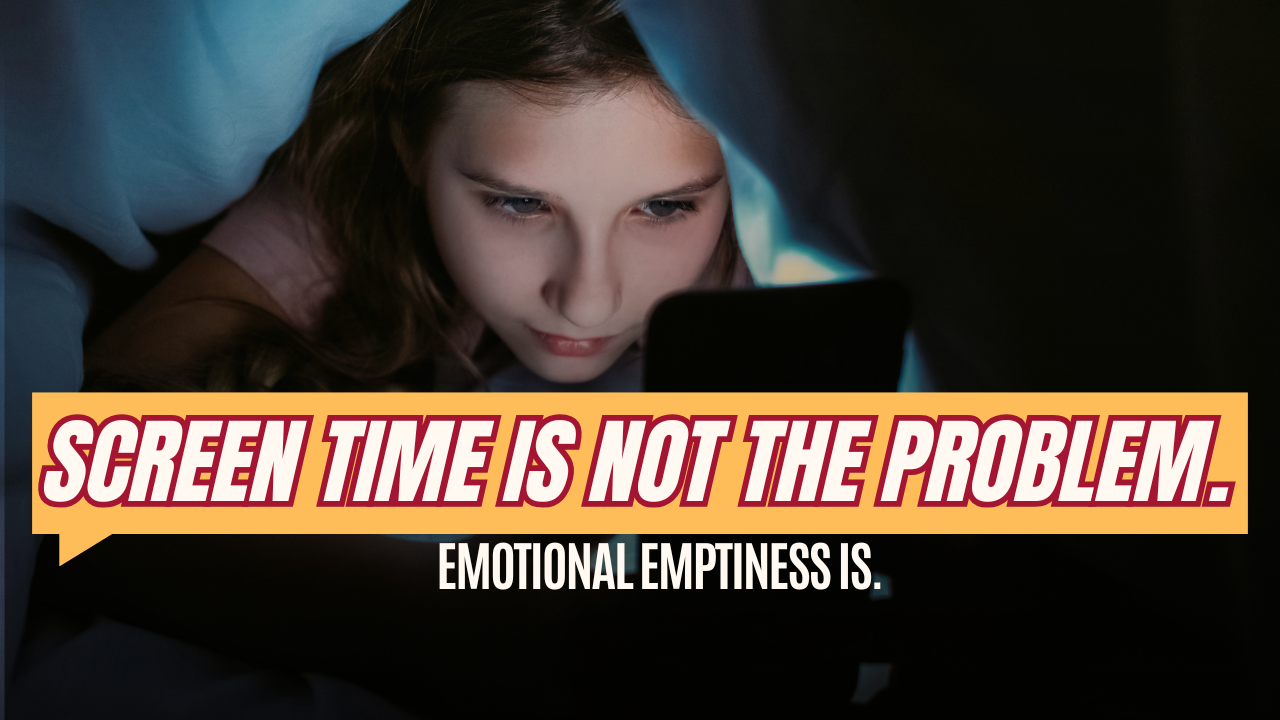
The screen is not the problem. The screen is the painkiller. The problem is what your child is trying to numb.
Why Taking the Phone Away Doesn’t Work
When you take your child’s phone away, what happens?
They don’t suddenly become creative. They don’t pick up a book. They don’t go outside and play. They don’t sit with you and have a conversation.
They rage. Or they sulk. Or they stare at the wall. Or they find another screen.
Why? Because you removed the symptom without addressing the cause.
Think about it this way: if someone is in chronic pain and they take a painkiller every day, taking away the painkiller doesn’t remove the pain. It just removes the only relief they had. Now they’re in pain AND they have no way to cope.
That’s what your child’s screen is a coping mechanism. The only one they have. Because nobody taught them any other.
Your child doesn’t reach for the phone because they’re lazy, undisciplined, or addicted in the clinical sense. They reach for it because something inside them is uncomfortable boredom, loneliness, anxiety, comparison, fear of failure, social pressure, family tension, sensory overwhelm and the screen makes that discomfort go away instantly. No effort. No vulnerability. No risk.
The screen is the cheapest, fastest, most accessible emotional regulation tool ever invented. And we handed it to them before we gave them any other tools.
What’s Actually Happening Inside Your Child
Children aged 8 to 14 are going through the most emotionally intense period of their lives. Their brain is restructuring. Their emotions are amplifying. Their social world is becoming more complex. Their identity is forming.
And they are doing all of this without any education about how their inner world actually works.
No one taught them what to do when they feel left out. No one taught them how to sit with boredom without panicking. No one taught them what anxiety feels like in their body before it becomes a meltdown. No one
taught them that comparison is a thought pattern, not a truth.
So they cope the only way the modern world has offered them: they scroll. They watch. They game. They disappear into a world where dopamine is instant and discomfort doesn’t exist.
The screen isn’t creating emotional problems. It’s REVEALING emotional emptiness that was already there. The emptiness is the gap between what your child feels and what they have the tools to process.
This is not a discipline issue. This is an education issue. And it’s the one education gap that no school in Ahmedabad or anywhere in India is addressing.
The Pattern Every Indian Parent Falls Into
Here’s the cycle most families in Ahmedabad and across Gujarat are stuck in:
Step 1: Child spends too much time on phone.
Step 2: Parents restrict phone access.
Step 3: Child has an emotional meltdown or becomes withdrawn.
Step 4: Parents feel guilty or exhausted.
Step 5: Phone returns sometimes with new rules, sometimes with no rules.
Step 6: Repeat.
This cycle repeats because both parent and child are focused on the BEHAVIOUR (screen time) instead of the EMOTION driving it.
In Indian homes where academic achievement is family honour, where “keep yourself busy” is the default advice, and where emotional conversations are rare children learn early that discomfort is something to avoid, not understand. Screens become the avoidance mechanism. Tuitions fill the schedule. Activities occupy the body. But nobody occupies the inner world.
The child stays busy. But they don’t learn to feel.
And then one day, they’re 16, and they can’t handle a breakup. They’re 18, and they collapse under exam pressure. They’re 22, and they don’t know who they are outside their achievements. And we wonder where it went wrong.
It went wrong at 10. When we fought about screen time instead of building emotional capacity.
What Emotional Capacity Actually Looks Like
Emotional capacity is the ability to sit with uncomfortable emotions without reaching for an escape.
A child with emotional capacity can feel bored without needing a screen. They can feel left out without spiraling. They can feel frustrated with homework without exploding. They can feel disappointed without the day being ruined.
This doesn’t mean they don’t feel these things. They feel them intensely. But they have the internal tools to hold those feelings, name them, understand them, and move through them without external numbing.
This is what emotional wellness for children actually means not the absence of difficult emotions, but the capacity to be with them.
Building this capacity requires three things no screen and no school can provide:
Body awareness learning to notice when emotions are building in the body before they become behaviour. The tight jaw. The racing heart. The stomach drops. These are signals. Children who recognise them can catch themselves before the meltdown.
Emotional vocabulary moving beyond “I’m fine” and “I’m angry” to “I feel excluded,” “I’m overwhelmed,” “I’m afraid I’m not good enough.” Precision of language creates precision of understanding.
Self-regulation not suppression. Not “controlling yourself.” The ability to feel a big emotion and choose a response instead of being hijacked by a reaction. This is a skill. It is built. It is taught.
No school in Ahmedabad teaches this. No tuition covers it. No personality development class builds it. This is Inner Literacy Education, the practice of teaching children how their mind, body, and emotions work together, in simple ways they actually understand and use.
What Changes When You Address the Emptiness
When a child develops emotional capacity, when they understand their own inner world, the relationship with screens changes on its own. Not because you took the phone away. But because the child no longer NEEDS the phone to feel okay.
Parents in Ahmedabad who have enrolled their children in The Becoming describe it like this:
“I didn’t take the phone away. I didn’t set new rules. But after a few weeks, he started putting it down on his own. He came to the kitchen and talked to me. I almost cried.”
“She still watches YouTube. But the frantic, glazed quality is gone. She watches for a bit and then does something else. The desperation is gone.”
“The homework fights stopped. Not because he loves studying now. But because he doesn’t need to escape from it anymore. He can sit with the discomfort of a hard problem.”
These shifts don’t come from discipline. They come from capacity. When the inner world has tools, the outer world doesn’t need to provide them.
What You Can Do This Week Before Anything Else
Before any program, any professional help, try this one shift:
The next time your child is on their phone and you feel the urge to take it away don’t. Instead, sit next to them. Not to lecture. Not to negotiate. Just to be present.
And when there’s a natural pause, ask one question: “How are you feeling right now? Not what you are watching. How are you actually feeling?”
You might get “fine.” You might get “leave me alone.” That’s okay. You’ve just done something radical you’ve told your child that their emotional state matters more than their screen time. Do it consistently, and the door begins to open.
But if you want that door to open faster, if you want your child to have the tools that no school, no app, and no parenting trick can provide, that’s what The Becoming was built for.
The Becoming Gujarat’s First Inner Literacy Education Program
The Becoming is not an anti-screen-time programme. It doesn’t lecture children about phone addiction. It doesn’t use fear tactics or restriction strategies.
It does something far more powerful: it fills the emotional emptiness that screens are compensating for.
Over 3 months of Inner Literacy Education, children aged 8 to 14 develop body awareness, emotional vocabulary, and self-regulation, the three capacities that make screens optional instead of essential.
Every Sunday in Ahmedabad. Small batches of 8–10 children. Guided by RasEsha Rabari : NLP and NAC practitioner, mother of two grown adults, and creator of Gujarat’s first and only Inner Literacy Education program. 300+ clients across Gujarat and India.
The next batch is enrolling now. Limited to 8–10 children.
Or start here: Is Your Child Emotionally Ready? — a free 10-question assessment that shows you where your child’s emotional capacity is strong and where Inner Literacy Education could change everything.
[Take the Free Assessment →]
Prefer WhatsApp? Message me directly at +91 75676 78611 — tell me your child’s age and what you’re seeing with screens. I’ll respond personally.
You might also find these helpful:
→ Your Child Isn’t Stubborn — They’re Overwhelmed
→ The 2 AM Google Search Every Indian Parent Makes
→ You’re Not Lost. You’re Unbecoming Who You Were Told to Be. (For mothers navigating their own emotional journey)
Written by RasEsha Rabari — Inner Literacy Education Expert & Emotional Wellness Coach, Ahmedabad, Gujarat. NLP & NAC Practitioner. Creator of Gujarat’s first Inner Literacy Education program for children aged 8–14. Author. 300+ clients across Gujarat and India.