
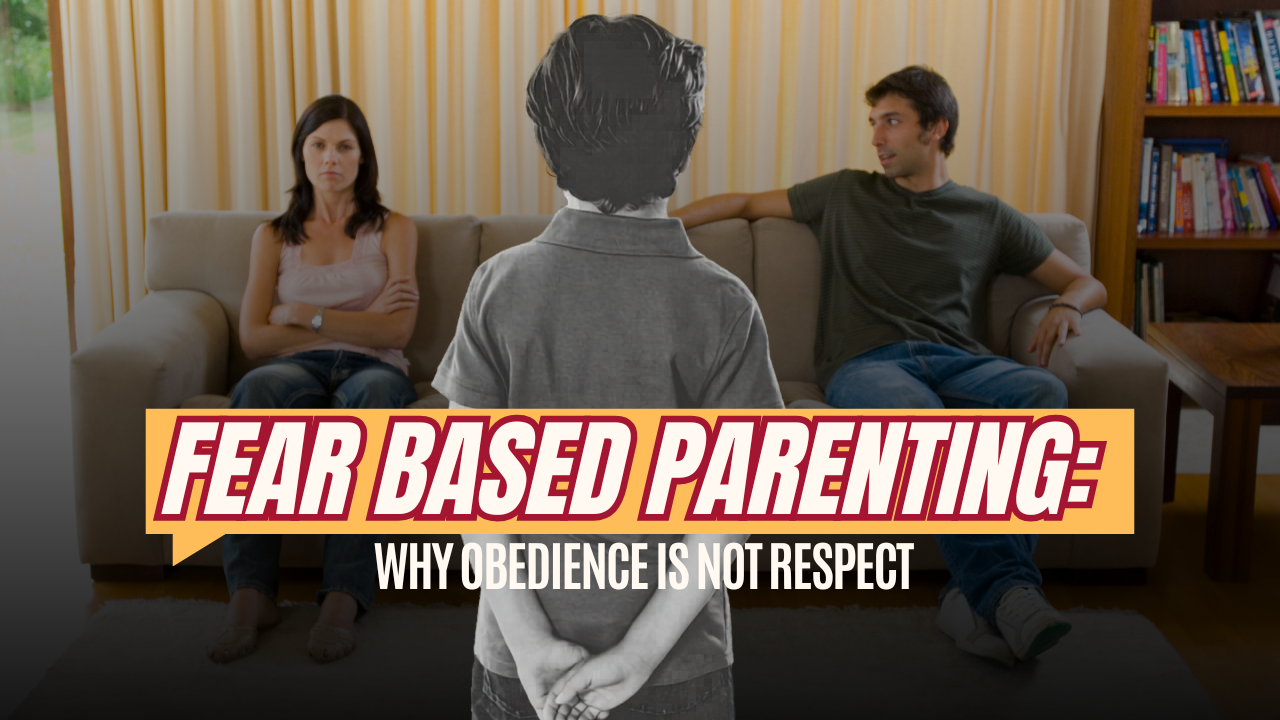
Your child listens to you.
They stop what they’re doing when you raise your voice. They say “sorry” when you look at them a certain way. They do their homework when you threaten consequences. They behave in front of guests. They perform well enough to keep the peace.
From the outside, everything looks fine. Your child is “well-behaved.” Relatives praise your parenting. Teachers don’t complain.
But there’s something you notice when no one else is watching:
Your child doesn’t come to you when they’re hurt. They don’t tell you what happened at school unless you ask six times. They don’t share what’s bothering them. They don’t laugh with you the way they used to. They’ve become quiet. Not peaceful, quiet. Guarded quiet.
And somewhere deep inside, a question is forming that you’re afraid to ask out loud:
Does my child respect me or are they just afraid of me?
If you’re a parent in Ahmedabad, in Gujarat, or anywhere in India this question matters more than you think. Because the answer determines not just your relationship with your child, but the emotional foundation they carry into every relationship for the rest of their life.
The Difference Between Obedience and Respect
Obedience says: “I will do what you say because I’m afraid of what happens if I don’t.”
Respect says: “I will listen to you because I trust you and I understand why it matters.”
Obedience is fast. It gets results. It makes family gatherings smooth and homework done on time. It looks like good parenting from the outside.
But obedience built on fear has a cost. And the cost is invisible until it isn’t.
A child who obeys out of fear learns these lessons:
“My feelings don’t matter only my behaviour matters.” “If I show what I really feel, there will be consequences.” “To be loved, I must perform.” “I can’t trust the people closest to me with my real self.”
These lessons don’t stay in childhood. They become the operating system for adulthood. They become the woman who can’t say no. The man who can’t express vulnerability. The spouse who avoids conflict at all costs. The parent who repeats the same patterns with their own children.
This is emotional inheritance. And it’s how fear-based parenting passes from generation to generation in Indian families not through intention, but through silence.
How Fear-Based Parenting Shows Up in Indian Homes
Let’s be honest about something most parenting articles in India won’t say directly:
Fear-based parenting is the cultural default in most Indian households. Not because parents are cruel. Because it’s what was modelled. Because it’s what “works.” Because in a culture where respect for elders is non-negotiable and academic success equals family honour, obedience is the fastest way to maintain control.
Here’s what fear-based parenting looks like in everyday life:
“I’ll count to three.” : Translation: comply before I escalate.
“Because I said so.” : Translation: your need to understand doesn’t matter.
“Look at Sharma ji’s son.” : Translation: you are not enough as you are.
“Stop crying or I’ll give you something to cry about.” : Translation: your emotions are inconvenient.
“After everything I’ve done for you, this is how you behave?” : Translation: love is conditional on performance.
None of these come from bad intentions. Every one of them comes from a parent who is overwhelmed, under pressure, and using the only tools they were given. You can’t give what you didn’t receive. And most parents in India didn’t receive emotional tools. They received rules.
The question is: now that you see it what do you do differently?
What Your Child Learns When You Lead With Fear
When fear is the primary motivator, your child develops what I call a compliance reflex they learn to scan for danger, suppress their authentic response, and produce the behaviour that keeps them safe.
This looks like:
At home: They agree to everything. They don’t argue. They don’t express opinions. They do what’s expected. Not because they understand. Because they’ve learned that self-expression leads to conflict.
At school: They might be the “good student” who never speaks up. Or they might become the “class clown” who performs for validation. Both are survival strategies one through invisibility, the other through entertainment.
With friends: They either dominate (replicating the control they experience at home) or they over-accommodate (replicating the submission). Neither is connection. Both are learned patterns of emotional survival.
Inside themselves: They stop trusting their own feelings. They start believing that what they feel is wrong, inconvenient, or too much. They develop what adults later call “self-doubt” or “imposter syndrome” or “people-pleasing.” But the root was planted here in childhood when their emotional world was corrected instead of understood.
Research confirms this: children raised in fear-based environments show higher rates of anxiety, lower self-esteem, reduced capacity for emotional expression, and weaker relationship skills in adulthood. The obedience worked. The cost was their inner world.
The Alternative: Connection-Based Parenting
Connection-based parenting doesn’t mean no boundaries. It doesn’t mean permissiveness. It doesn’t mean letting your child “do whatever they want.”
It means the boundary comes AFTER the connection not instead of it.
Here’s the difference in practice:
Fear-based: “Stop crying and go do your homework.” Connection-based: “I can see you’re upset. What’s going on? Let’s talk for a minute, and then we’ll figure out homework.”
Fear-based: “If you don’t listen, I’m taking your phone for a week.” Connection-based: “I need you to hear me right now. When you ignore me, I feel like we’re disconnecting. Can we find a way that works for both of us?”
Fear-based: “Your marks are embarrassing. What will people think?” Connection-based: “These marks don’t define you. But I can see you’re struggling. Let’s figure out what’s going on underneath.”
The result? In the first approach, the child complies. In the second, the child UNDERSTANDS. They develop emotional vocabulary. They learn that their feelings are data, not danger. They learn that they can be imperfect and still be loved.
This is not soft parenting. This is the hardest parenting there is because it requires YOU to regulate YOUR emotions first. You can’t teach emotional wellness to your child if your own nervous system is in fight-or-flight every time they don’t listen.
And that’s the uncomfortable truth: fear-based parenting isn’t really about the child. It’s about the parent’s own unprocessed emotions being projected onto the child’s behaviour. When you yell “Why can’t you just listen?” the frustration isn’t about homework. It’s about control. About fear. About your own childhood echoes.
If you heal, your child won’t have to.
The Framework That Changes Everything
In my work with families in Ahmedabad and across Gujarat, I use a model called Connection-Trust-Behaviour:
Connection first. Before you can influence behaviour, your child needs to feel emotionally safe with you. Safety doesn’t mean absence of rules. It means presence of understanding.
Trust second. When a child feels connected, trust builds naturally. They start sharing. They start expressing themselves. They start coming to you instead of hiding from you.
Behaviour last. When connection and trust are established, behaviour changes from the inside. Not because the child fears consequences. Because they understand themselves. Because they trust you enough to let you guide them.
This is the reverse of how most Indian parenting works where behaviour is demanded first, trust is assumed, and connection is hoped for.
Flipping this order changes everything. And it’s the foundation of all Inner Literacy Education work at The Becoming.
What You Can Start Tonight
Choose one interaction today where you would normally correct, lecture, or raise your voice. Instead:
Pause. Take one breath before responding.
Ask instead of tell. “What were you feeling when that happened?” instead of “Why did you do that?”
Acknowledge before redirecting. “I understand that’s frustrating” before “But we still need to…”
Separate the child from the behaviour. “I love you AND this behaviour needs to change” instead of “You always do this.”
One interaction. One shift. That’s all it takes to begin breaking the cycle.
If this resonated, if you see yourself in the patterns described here, not just as a parent but as someone who was RAISED this way, know that you are the bridge generation. You are the one who can stop the cycle. Not by being perfect. By being aware.
The Becoming : Where Children Learn What We Never Did
The Becoming exists because no school in India teaches children how to understand their own emotional world. And no school teaches parents how to connect with children beyond compliance.
Over 3 months of Inner Literacy Education, children aged 8 to 14 in Ahmedabad develop the three things fear-based parenting cannot build:
Body awareness : recognising emotions in the body before they become behaviour.
Emotional vocabulary : naming what they feel with precision, not just “fine” or “angry.”
Self-trust : the quiet confidence that comes from understanding yourself, not from being told you’re good enough by someone else.
Every Sunday. Ahmedabad, Gujarat. Small batches of 8–10 children. Guided by RasEsha Rabari : NLP and NAC practitioner, mother of two grown adults, creator of Gujarat’s first and only Inner Literacy Education program. 300+ clients across Gujarat and India.
The next batch is enrolling now. Only 8–10 seats.
[Take the Free Assessment: Is Your Child Emotionally Ready? →]
Prefer WhatsApp? Message me directly at +91 917567678611 tell me your child’s age and what you’re seeing. I’ll tell you honestly whether The Becoming is the right fit.
You might also find these helpful:
→ Your Child Isn’t Stubborn — They’re Overwhelmed
→ Screen Time Is Not the Problem. Emotional Emptiness Is.
→ The 2 AM Google Search Every Indian Parent Makes
Written by RasEsha Rabari : Inner Literacy Education Expert & Emotional Wellness Coach, Ahmedabad, Gujarat. NLP & NAC Practitioner. Creator of Gujarat’s first and only Inner Literacy Education program for children aged 8–14. Author. 300+ clients across Gujarat and India.