

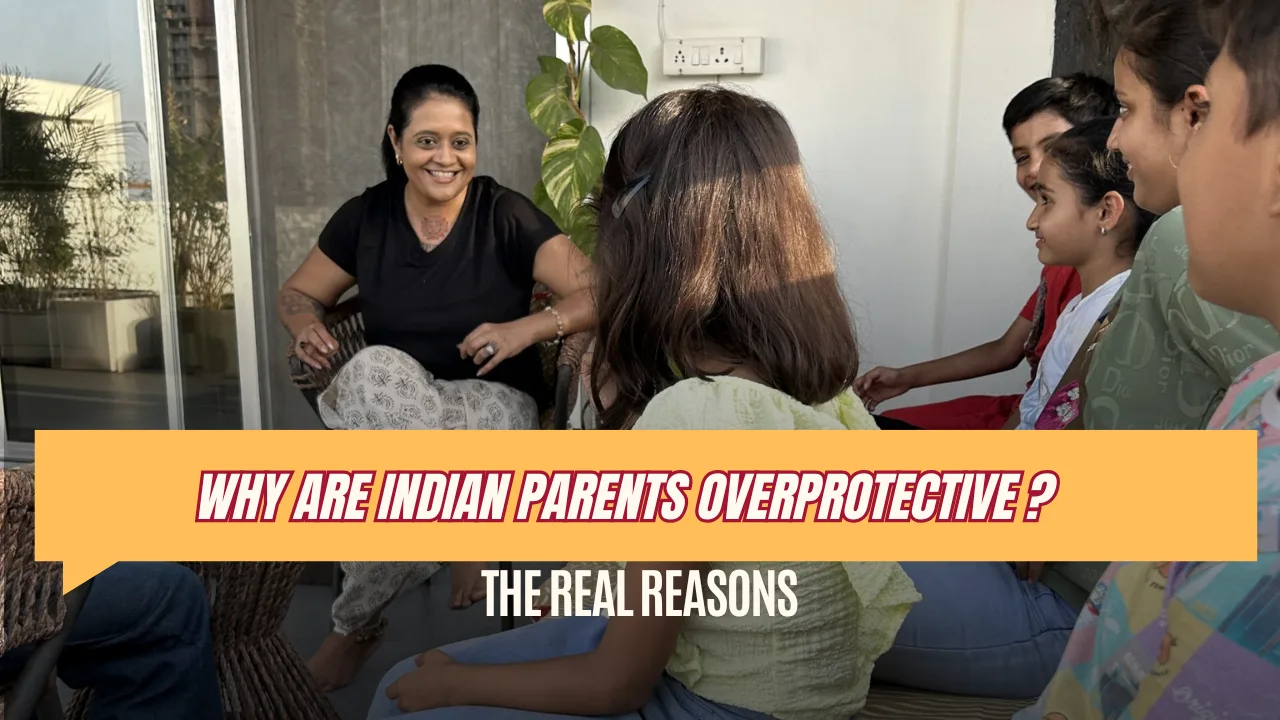
You called your 22-year-old today to ask if they ate. You checked your 14-year-old’s bag before school, even though they asked you not to. You said no to a school trip because “what if something happens.”
You’re not overprotective because you don’t trust your child. You’re overprotective because you love them so much that the thought of them getting hurt, even a little, feels unbearable. And I understand that. Because I’ve been that parent. I’ve held too tight, more than once, because letting go felt like abandoning. This article isn’t going to attack Indian parents. It’s going to understand why Indian parents are so overprotective, and then, gently, show what it costs.
Understanding What “Overprotective” Actually Means

Every child needs protection. That’s healthy. Overprotection is when the protection continues past the point where the child needs to learn to handle things themselves, when the shield stays up so long that the child never builds their own armour.
Protection says: I’ll keep you safe while you learn. Overprotection says: I’ll keep you safe so you never have to learn. That’s the difference, and it’s exactly why an Inner Literacy Education program for children focuses on building confidence, emotional understanding, and independence from within.And it’s not always obvious, because overprotective Indian parents rarely see it as overprotection. It feels like love. It is love. Just love that hasn’t learned to let go yet. And I’ve been on both sides of it.
Why Are Indian Parents Overprotective? The Real Reasons
1. Love Expressed as Protection

In Indian culture, love isn’t expressed through words. It’s expressed through acts of protection, sacrifice, and provision. We don’t say “I love you.” We say “did you eat?” “Take a jacket.” “Don’t go there.” The protection is the love language.
Nobody taught us to express love through freedom. We were taught to express love through control. Not because we’re controlling people. Because in Indian homes, control is care. And separating the two feels almost impossible.
2. A History of Real Insecurity
Previous generations faced real scarcity, financial, social, physical safety. Our parents and grandparents grew up in environments where the world genuinely was dangerous. That survival instinct didn’t disappear just because the world got safer. It got passed down as anxiety, as vigilance.
Your mother worried because her mother had real reasons to worry. The world changed. The worry didn’t. Sometimes, these are also the first signs your child may need emotional wellness support.
3. Family Reputation Is Personal Reputation

In Indian families, a child’s behaviour reflects on the entire family. “What will people think?” isn’t just a phrase, it’s a genuine fear that governs decisions. So Indian parents are overprotective not only about safety, but about preventing anything that might bring judgment on the family.
We’re not always protecting our children from the world. Sometimes we’re protecting ourselves from the world’s opinion of our children. And that’s a hard truth to sit with.
4. They Were Raised the Same Way

You parent the way you were parented unless you consciously choose to do it differently. Most Indian parents weren’t given freedom. They weren’t asked what they wanted. So they don’t know how to give those things to their children, because they never received them.
You can’t give what you weren’t given. Not because you don’t want to. Because you don’t know how it feels. Giving your child freedom when you never experienced freedom yourself, that’s not natural. It’s learned. And learning takes time and support.
5. Wanting to Spare Children Their Own Pain
Every parent carries wounds, failed relationships, career regrets, moments of humiliation. The instinct is: my child will not go through what I went through. So they prevent, restrict, control the environment. The intention is beautiful but the outcome isn’t because a child who never experiences manageable pain never builds the capacity to handle it.
The deepest overprotection comes from the deepest wounds. You’re not controlling your child. You’re trying to rewrite your own story through them. And that weight, your pain becoming their cage, is one of the most heartbreaking patterns I see.
6. The Cultural Belief That Discomfort Is Dangerous

In Indian parenting, discomfort is treated as something to eliminate, not learn from. Child is upset? Fix it. Child is struggling? Remove the struggle. But emotional growth requires discomfort. A child who never sits with failure never learns resilience.
We’ve confused comfort with safety. They’re not the same thing. A child can be uncomfortable and safe. In fact, that’s where all growth happens. But we rush to remove it before it can teach them anything.
Later, many parents wonder, “My child is smart but can’t focus.”
7. The Fear of Letting Go

Underneath all the other reasons, there’s a fear most Indian parents can’t name: if I let go, do I become irrelevant? If my child doesn’t need my protection, do they still need me? Being needed feels like being loved. And letting go feels like losing love.
The hardest part of parenting isn’t protecting your child. It’s realizing the goal of protection was always to make yourself unnecessary. For an Indian parent who has poured everything into their child, that feels like a kind of death. But it isn’t. It’s the highest form of love. Letting go so they can stand.
The Quiet Cost on Children
This is one of the reasons why Ahmedabad parents are turning to emotional coaching for kids. The children who come to me most over-protected aren’t the ones acting out. They’re the ones who are too quiet. Too compliant. Too perfect. And when you look closely, they’re not confident. They’re afraid, afraid that without someone protecting them, they can’t survive. That’s not safety. That’s dependency dressed as love.
It shows up as the child who can’t make a decision alone. The one who needs reassurance for everything. The one who performs well but collapses at the first real failure. An egg cracked from the outside, life ends. An egg cracked from the inside, life begins. Your child needs to crack open from their own understanding, not from your force, not from your fear. From their own becoming.
How to Find the Balance Between Protection and Growth
I’m not going to tell you to stop protecting your child. That’s not realistic, and it’s not what I believe. What I believe is this: before you protect, pause. And ask yourself one question.
“Is this a real danger, or just discomfort?”
Ask yourself honestly. Not once. Every time you’re about to say no.
If it’s danger, protect. If it’s discomfort, let them feel it. That’s where growth lives.
“Can my child handle this with support, instead of rescue?”
There’s a difference between standing behind your child and standing in front of them. One builds them. The other blocks them.
“Am I protecting my child, or managing my own anxiety?”
Honest question. Sometimes we say no because we can’t handle the worry, not because the child can’t handle the situation.
“What would I want for them at 30?”
If you want a 30-year-old who can navigate life, you need to let the 12-year-old start practising. Independence at 30 isn’t built at 30. It’s built at 10, 12, 14, one small freedom at a time.
“Am I teaching them how to handle this, or just preventing it?”
Prevention has an expiry date. You can’t prevent it forever. But if you teach them how to handle difficulty, that lasts for life.
When Overprotection Becomes a Pattern Worth Changing
If you recognised yourself in this article, that’s not a problem. That’s awareness. And awareness is where change starts.
Inner Literacy Education gives children the tools to handle what you’ve been protecting them from, so you can let go. That’s why many parents eventually start asking whether emotional education or personality development is the right choice for their child. Not with fear. With confidence that they have what they need inside.
The Becoming is Gujarat’s first and only Inner Literacy Education program for children aged 8–14. Every Sunday in Ahmedabad. 6 months. 24 sessions. Small batches.
→ Book a Free 15-Minute Discovery CallFrequently Asked Questions
Why are Indian parents so strict?
Strictness comes from love expressed through control, from a culture that equates obedience with respect, from generations where rules kept children safe in genuinely unsafe environments. The world has changed. The approach hasn’t yet for most families.
Is overprotective parenting bad for a child’s development?
Overprotection with love isn’t bad. But over time, it can prevent the child from building the emotional muscles they need to handle life independently. The intention is beautiful. The outcome needs awareness.
What are the signs of overprotective Indian parents?
Making decisions the child is capable of making. Answering questions directed at the child. Rescuing from every discomfort. Feeling anxious when the child is out of sight. Saying no to age-appropriate experiences out of fear.
Are Indian parents overprotective because they don’t trust their children?
No. Most Indian parents are overprotective because they don’t trust the world. The child isn’t the concern. The world is. And that fear of what the world might do to their child is what drives the shield.
How can Indian parents stop being overprotective without being neglectful?
It’s not all or nothing. You don’t go from shielding to abandoning. You go from shielding to equipping. Teach your child how to handle what you’ve been handling for them. That’s not letting go. That’s leveling up.