

You’ve probably just watched your child melt down over something small. Or noticed they can’t name a single feeling beyond “fine” and “angry.” Or realised your child is smart but can’t seem to focus or manage their emotions. And then, immediately: how? Nobody taught me.
You want to teach your child emotional intelligence. But here’s the honest question underneath that: who taught YOU?
If the answer is nobody, you’re not alone. Most of us are trying to give our children something we never received ourselves. And that’s not a weakness. That’s the bravest kind of parenting there is. And if you’re looking for structured emotional education for children, this article will show you what to start at home and when to seek guided support.
What Is Emotional Intelligence in a Child?

A child without emotional intelligence gets a bad grade and thinks “I’m stupid.” A child WITH emotional intelligence gets a bad grade and thinks “I’m disappointed. This feels heavy. But it doesn’t mean “they are not capable.”
Same child. Same grade. Completely different inner experience. THAT’S emotional intelligence. Not the absence of difficult feelings. The ability to feel them without being destroyed by them.
In simple terms, emotional intelligence comes down to four things: knowing what you feel, knowing what to do with what you feel, noticing what others feel, and navigating relationships with awareness.
“Still weighing emotional education vs personality development for your child? That comparison is worth reading before you decide”
Why Emotional Intelligence Matters More Than Ever
Research consistently shows that a child’s emotional intelligence predicts their long-term success in relationships, in career, in how satisfied they feel with their own life more reliably than their IQ does.
Your child is growing up in a world that’s more emotionally complex than anything you or I faced at their age. Social media comparison, Academic pressure starting at age 6, Friendship dynamics that shift hourly on WhatsApp groups, etc. A child without emotional intelligence doesn’t just struggle with feelings. They struggle with EVERYTHING. Because everything runs on emotions, even the things we like to believe are purely logical.
IQ might get your child into a good college. Emotional intelligence decides whether they survive it.
Signs Your Child May Need Help Building Emotional Intelligence
In my work with families in Ahmedabad, these are the patterns I see most often in children who haven’t yet developed emotional intelligence, these are the signs your child needs emotional support. Not because something is wrong with them. Because nobody showed them how.
They have two emotional labels:
“I’m fine“
“I’m angry.”
Everything else is unlabelled and comes out as behaviour. Small frustrations create big explosions. The reaction never matches the trigger.
- They can’t tell you what’s wrong, only that something “is wrong”.
- They struggle with friendships, either dominating, withdrawing, or over-accommodating to be liked.
- They say ‘sorry’ the moment tension appears not because they understand what happened, but because they’ve learned that ‘sorry’ makes the discomfort stop.
- They compare themselves constantly, and their self-worth rises and falls with external feedback.
- They can’t sit with disappointment since every setback feels permanent.
If you recognise your child in any of these, it doesn’t mean they’re falling behind. It means they haven’t been taught yet. And the beautiful thing about emotional intelligence? Unlike IQ, it can be taught. At any age. Starting today.
How to Teach Emotional Intelligence to a Child: 8 Practical Ways
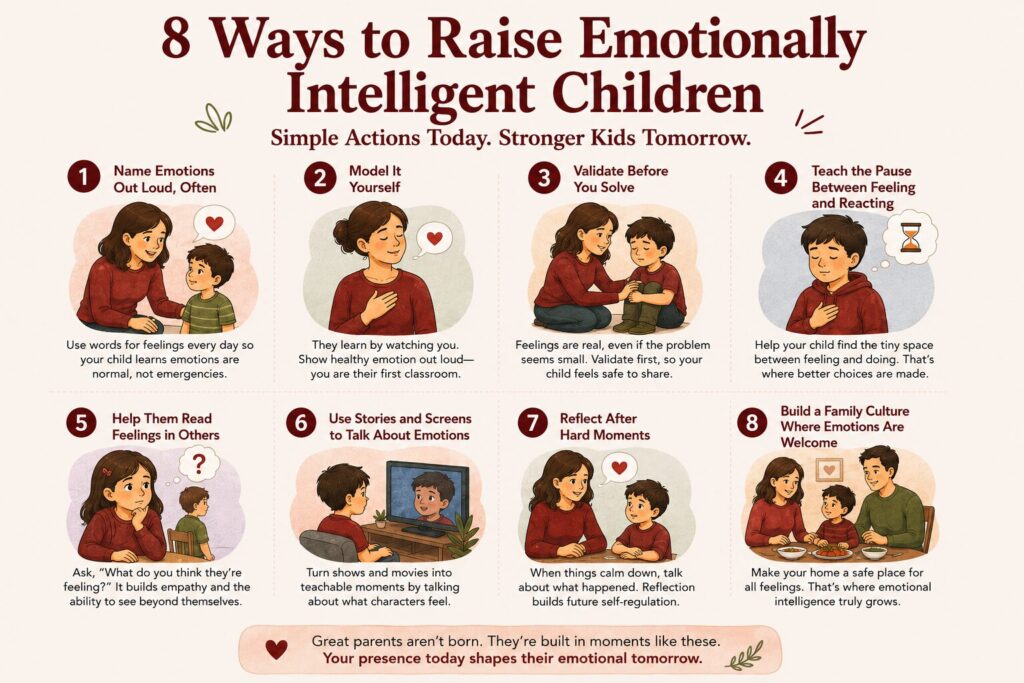
Most parenting advice on emotional intelligence stops at “talk about feelings.” That’s a start. But it’s like telling someone to “play music” without teaching them an instrument. These eight habits go further. They’re the small, repeatable moments where a child actually learns to recognise, sit with, and move through emotion. Not just name it.
1. Name Emotions Out Loud, Often
Your child learns emotional vocabulary the same way they learned language, by hearing it spoken around them. If emotions in your house are only named during crises, your child learns that emotions are emergencies. If emotions are named casually, daily, in passing your child learns that emotions are just normal. And that changes everything.
2. Model It Yourself
Children don’t learn emotional intelligence from what you TELL them. They learn it from what they WATCH you do. If you want your child to express emotions healthily, start by doing it yourself. Out loud. Where they can see it. You are their first classroom.
3. Validate Before You Solve
The fastest way to shut down a child’s emotional world is to tell them their feelings are too much. “Stop crying.” “You’re overreacting.” Every one of these sentences teaches your child: what I feel is wrong. And a child who believes that stops sharing them. Permanently. This is often how overprotective parenting patterns begin. Parents control more because the child shares less. Validate first. Always.
Even when the problem seems small to you it’s not small to them. Your job is to see it from THEIR height, not yours.
4. Teach the Pause Between Feeling and Reacting
I teach this to every child who comes to The Becoming. There is a moment, a tiny, almost invisible moment between what you feel and what you do. Most people don’t know it exists. But once a child discovers it, they realise they’re not a slave to their reactions. They have a choice. That single discovery changes how they handle everything.
5. Help Them Read Feelings in Others
Emotional intelligence isn’t just about understanding YOUR OWN feelings. It’s about noticing that other people have feelings too. You can practise this anywhere at the dinner table, during a movie, even walking through a mall. “What do you think that person is feeling right now?” That one question, asked regularly, builds something no school teaches. This is the ability to see the world from inside someone else’s experience.
6. Use Stories and Screens to Talk About Emotions
Your child watches hundreds of hours of content. Most of it washes over them. But if you sit with them for even one scene and ask “what do you think that character was feeling?” you’ve turned entertainment into education. The screen becomes a mirror. And your child practises emotional thinking without even realising it.
7. Reflect After Hard Moments
The lesson is never in the storm. It’s in the calm after. Wait until the emotions have settled. Then ask gently, “what was that about?” Not to scold. To understand. A child who is taught to reflect after difficult moments eventually learns to reflect DURING them. And that’s the beginning of real self-regulation.
8. Build a Family Culture Where Emotions Are Welcome
You can teach your child every technique in this article. But if the culture of your home treats emotions as weakness, none of it will stick. The most powerful thing you can do is build a home where feelings are as welcome as food. Where “I’m sad” doesn’t get fixed but it gets heard. Where “I’m angry” doesn’t get punished but it gets understood. THAT is where emotional intelligence actually grows. Not in a program. Not in a book. At your dinner table.
How Emotional Intelligence Grows With Age
Don’t expect your 6-year-old to regulate like a 14-year-old. Emotional intelligence develops in stages. Here’s what each stage looks like, so you can meet your child where they are, not where you wish they were.
- Ages 4–7: This is when emotional vocabulary begins. They can start naming simple feelings like happy, sad, angry, scared. They won’t regulate well yet. They WILL melt down. Your job at this age isn’t to stop meltdowns. It’s to name what’s happening during them. “You’re frustrated because the toy broke. That makes sense.”
- Ages 8–11: This is the golden window and I say this from experience, not theory. They can start understanding WHY they feel what they feel. They can begin learning the pause between feeling and reacting. This is when Inner Literacy Education creates the deepest impact, because the brain is wiring emotional pathways that will last into adulthood.
- Ages 12–14: Emotions intensify dramatically. Identity formation begins. Social complexity explodes. A child who has emotional intelligence built during ages 8–11 navigates this stage with awareness. A child who doesn’t often gets overwhelmed, withdrawn, or reactive. This is the age where parents come to me and say “I feel like I’ve lost my child.” Usually what they mean is: “My child’s emotional world outgrew the tools they had.”
When Teaching at Home Isn’t Enough

Everything in this article is something you can do at home. And I genuinely believe parents are a child’s first emotional teachers. But I also know, after 9 years and 300+ families (and seeing why parents are choosing emotional education) in Ahmedabad and across Gujarat, that sometimes home isn’t enough. Not because you’re not enough. Because you’re also the person your child has the most complicated feelings about. They love you, AND they’re embarrassed to show you weakness. They trust you, AND they’re afraid to disappoint you. Sometimes a child needs a space outside the family with someone who isn’t their parent to discover parts of themselves they can’t discover at the dinner table.
That’s the space The Becoming creates. Founded by Rasesha Rabari, it is Gujarat’s first and only emotional intelligence program for chil
→ Book a Free 15-Minute Discovery Calldren aged 8–14. Every Sunday in Ahmedabad. 6 months. 24 sessions. Small batches of 8–10 children
Frequently Asked Questions
At what age should I start teaching emotional intelligence to my child?
As early as possible, but each age has a different capacity. Ages 4–7 are about vocabulary. Ages 8–11 are the golden window for building real emotional skills. Ages 12–14 need depth and support. There’s no ‘too late.’ But there IS a window where it’s most natural, most effective, and most lasting. That window is 8–14.
How do I grow emotional intelligence in my child?
By practising it yourself first. Children learn emotions by watching you, not by listening to you. Name your feelings out loud. Validate theirs before solving. Teach the pause between feeling and reacting. Build a home where emotions are normal, not emergencies.
Can emotional intelligence be taught to all children?
Yes. Without exception. Emotional intelligence is not a talent some children have and others don’t. It’s a skill set. Like reading or swimming. Some children pick it up faster. Some need more support. But every child can learn it when they’re taught with patience and the right approach.
What is the difference between emotional intelligence and being well-behaved?
A well-behaved child follows rules. An emotionally intelligent child understands WHY the rules matter. A well-behaved child says sorry because they were told to. An emotionally intelligent child says sorry because they understood what their actions caused in someone else. One is performance. The other is understanding. They look the same from the outside. They’re completely different on the inside.
How long does it take to develop emotional intelligence in a child?
Honest answer, it’s not a 4-week course. Initial shifts are visible in 3–4 weeks when consistent effort is applied. Real depth takes 4–6 months. Lasting change is that change that becomes part of who your child is. It may take 6–12 months of consistent practice, both at home and in a supportive environment. This is why The Becoming is 6 months, not 6 weeks. Because depth takes time.